By: Brian Timmer
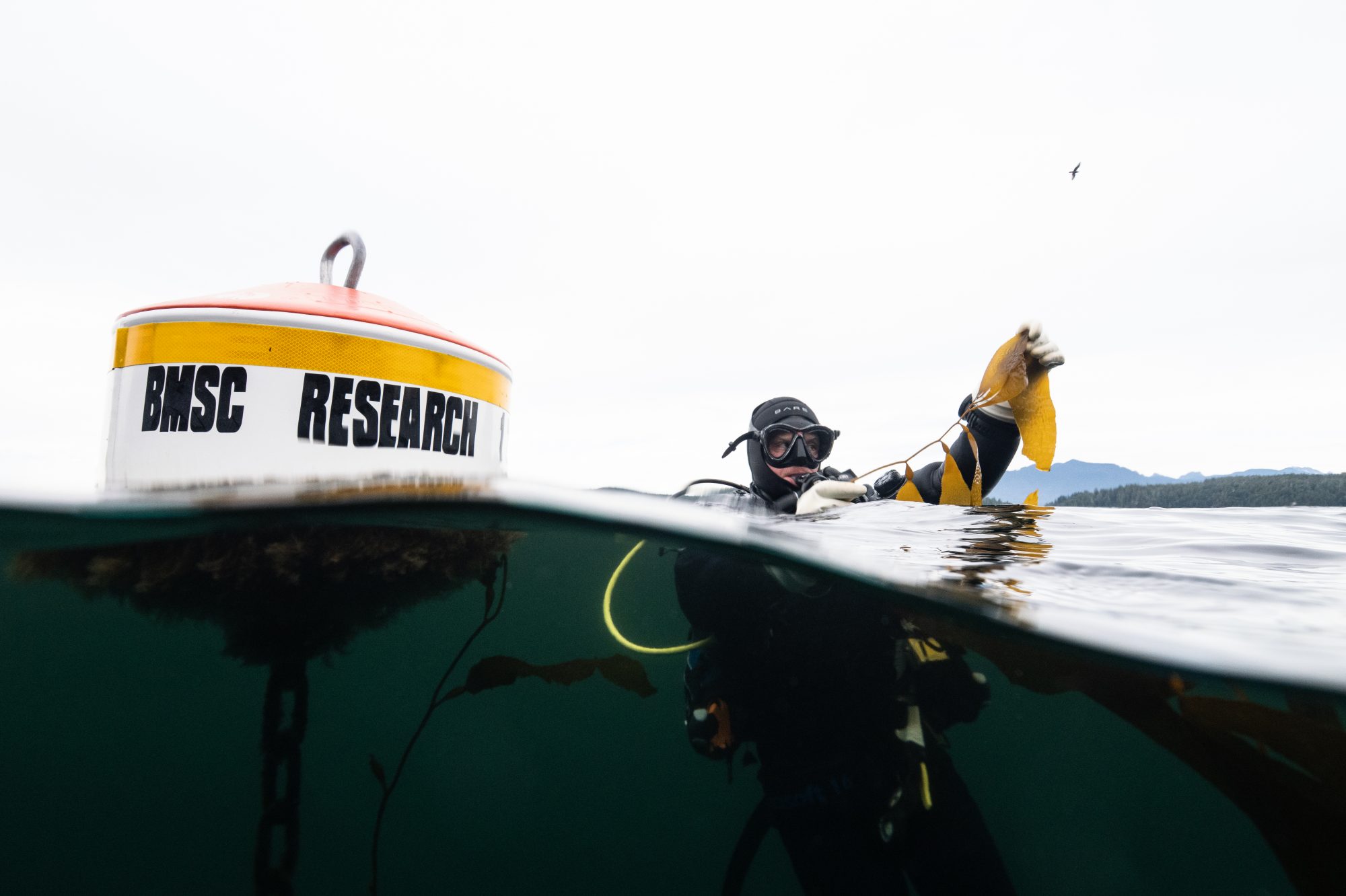
Roughly a decade ago, I was a SCUBA instructor. Most of the diving that I taught was in the Salish Sea, just north of Nanaimo, on the east coast of Vancouver Island. My favourite thing to do while diving there was to explore the kelp forests that grew just offshore (Figure 1).
By early summer, a large bull kelp forest would form, floating at the surface with intricate canopies of kelp blades hanging down into the water column. I would sit back and watch the underwater world moving around me: kelp swaying in the current with light filtering through the canopy, schools of herring darting in and out of the kelp, or a big rockfish hovering above the bottom waiting for their next snack. It was like being in an aquarium.
Eventually, my love of the ocean inspired me to go back to school and study marine ecology. During the first year of my undergraduate degree, the largest and most intense marine heat wave ever recorded hit the west coast of North America.

In just a single summer, all of the bull kelp forests at my favourite dive sites disappeared, never returning since. I was devastated. I turned my academic focus towards understanding why these kelp forests had disappeared, and what could be done about it, as it was becoming clear that kelp forests were declining in many different areas of our coast.
As an undergrad, I studied how all the complex pieces of a kelp forest ecosystem come together and interact with one another. I learned how climate change is driving more frequent and intense marine heat waves, like the one I had watched kill off all the kelp. I also learned that we as humans are a crucial part of these ecosystems, and how colonial practices and mismanagement had thrown some kelp forest ecosystems out of whack long before climate change was an issue.
During my master’s in remote sensing (i.e., using satellites and drones for monitoring), I worked with various groups who were studying kelp in B.C., many of whom worked closely with First Nations Guardian programs. Remote sensing is a highly valuable tool for monitoring kelp forests, but these sorts of methods work best when paired with ground truth surveys and local knowledge.
Many coastal First Nations are working to build/expand marine monitoring and restoration programs within their own territories, enabling inherent titles and rights for sovereignty, but equipment and training are expensive, and technical barriers exist when determining methodologies and training personnel. The context of climate change, as well as impacts and actions that result from it, are inseparably linked to the daily and lived experiences of First Nations who have been living reciprocally and in balance with all creation for thousands of years1.
My RESEARCH
After my masters, I began a PhD program researching the effects of climate change on nearshore ecosystems. My research is focused within one of the fastest warming marine regions on the west coast of Canada, the Strait of Georgia in the northern Salish Sea — the same place that I watched kelp forests disappear a decade ago. Part of my thesis focuses on whether we can enact ‘climate smart’ restoration in this region, using fast-growing kelps (like bull kelp) to create food and habitat for key species, including salmon, herring, and rockfish. This work has been done in partnership with the Kelp Rescue Initiative (KRI), a new organization based out of the Bamfield Marine Sciences Centre that restores kelp forests in B.C. At KRI, our mission is to advance and share knowledge for ecosystem restoration through making our research and restoration knowledge widely accessible. We work closely with First Nations partners, who often have overlapping or shared territory on the water and face similar marine resource challenges, but may lack forums or capacity to collaborate on marine issues.

CENTERING RESEARCH IN RECIPROCITY
In all of our work, the findings and knowledge are made openly available, shared with, and ideally co-developed alongside Coastal First Nations, but it was important to me personally that my research had direct and immediate tangible benefits to the First Nations in whose territories I was conducting research.
I am Stó꞉lō, from Chawathil, on my dad’s side. Stó꞉lō are “People of the River”, which means that salmon runs have been a source of life itself to my ancestors. Every salmon smolt that left the Fraser River would also pass through the kelp forests of the Salish Sea, finding food and shelter in their floating canopies on their way to the open ocean. We grew up very disconnected from Stó꞉lō culture, and for me, I think that this disconnect has made my drive to conduct reciprocal research even stronger, almost as some form of validation and reconnection with my Coast Salish culture.
During grad school, focused coursework on coastal climate solutions as well as co-creating science with Indigenous communities helped shape my knowledge and outlook of reciprocal research, and taught me that often we need to think outside the box of the traditional academic lens to ensure our research is useful in the real world. However, there are many systemic barriers that can make reciprocal research difficult to enact, including accessibility to long-term sustainable funding, capacity constraints within an academic timeline, and challenging logistics or methodologies.
With all of this in mind, early on in my PhD I helped write a grant that funded KRI’s ongoing work, grounding our focus in support of Indigenous-led monitoring and restoration. With part of this funding, we were able to bring on a Pune’luxutth elder, Connie Crocker (Xwulsiim), as a full-time First Nations liaison to help build meaningful relationship with the many different First Nations around B.C. We also use this funding to host annual regional round tables with First Nations to identify both regional and Nation specific priorities (Figure 2). A key theme that arises in these round tables is training and capacity building for First Nations Guardian teams related to monitoring and kelp restoration, as well as needs for funding and infrastructure to build long-term sustainable programs.

Kelp restoration methodologies are still being developed, and many of the restoration methods we test at KRI are new to the B.C. coast. Certain types of restoration require complex infrastructure, like aquatics facilities to act as kelp nurseries for growing kelp before it can be out-planted for restoration. Even with knowledge and infrastructure in place, there can be capacity related barriers to restoring or even simply monitoring healthy or restored kelp forests, as much of this work involves either SCUBA diving or using various technologies like underwater drones and cameras.
We are helping to reduce these barriers in multiple ways. Recently, remotely operated vehicles (ROVs, i.e., underwater drones) have become more accessible as a tool for underwater monitoring instead of SCUBA divers. As an experienced ROV pilot, I was able to put together a small ‘introduction to ROVs’ curriculum, which we have been sharing with First Nations’ Guardian programs along with on (and under) the water ROV pilot training. The cost of hiring commercial dive contractors for a single day of monitoring can be instead purchase an entry level ROV and support subtidal monitoring over multiple years. Additionally, the hand-eye coordination required to pilot an ROV via controller is a highly related skill to playing video games, making ROV programs a great opportunity to engage First Nations youth in monitoring programs. Even if Guardians themselves are trained divers, affordability of dive programs is still a large concern. Underwater time-lapse cameras can be a powerful tool for remotely monitoring underwater ecosystems, reducing cost and effort associated with traditional SCUBA surveys. As part of my PhD I have designed underwater time-lapse cameras along with an openly available manual that contains links to buy all the needed parts, instructions for assembly and use. The manual also offers tips and methods for analyzing the images taken by the cameras, offering a tangible solution to First Nations that are looking to maximize monitoring efforts while minimizing costs.
In addition to supporting marine monitoring programs to enhance reciprocity within my PhD thesis research, my time at the Kelp Rescue Initiative has also given me opportunities to directly support Indigenous-led kelp forest restoration through advising on ongoing Indigenous led projects, as well as the co-creation and grant writing for new restoration projects with First Nations partners.
We have recently built kelp nurseries on both the east and west coasts of Vancouver Island, creating permanent infrastructure that is reducing some of the most costly and technical logistical barriers to enacting kelp restoration projects. Together, these monitoring and restoration programs support Indigenous sovereignty within First Nations territories by reducing financial, logistical, and capacity related barriers to marine monitoring and kelp forest restoration.
LINKAGES TO FIRST NATIONS CLIMATE STRATEGIES
On a broader level, reciprocal research can support climate change adaptation and mitigation for First Nations by supporting the four priority pathways outlined in the B.C. First Nations Climate Strategy Action Plan (FNCSAP)2, as well as the priorities within the Action Plan For Disaster Risk Reduction (APDRR)3. The priorities of the ADPRR are to understand and invest in disaster risk through strengthening governance and enhancing preparedness.
The work we are doing, both directly related to my thesis outputs and the Kelp Rescue Initiative’s objectives, and more broadly through the volunteered time I spend supporting Indigenous led restoration and monitoring, are in direct support of both the FNSCAP and the APDRR (Figure 3). For example, by providing First Nations access to kelp nurseries, or providing logistical support for ecosystem restoration, we are helping to reduce barriers for Indigenous-led ecosystem restoration, ultimately supporting the key priorities of both the FNSCAP and APDRR. On a smaller scale, sharing the direct outputs of my thesis research (e.g., peer-reviewed research and mapping outputs) more specifically support the APDRR’s priority of understanding disaster risk and enhancing disaster preparedness, while also supporting the ability of First Nations to protect their land and water through enhanced understanding of ecosystem function and change.

LESSONS & RECOMMENDATIONS
For me, the opportunity to build meaningful reciprocal relationships within the work that I am most passionate about has been an absolute privilege. A PhD thesis can be challenging enough on its own, and there are numerous lessons that I have learned so far, about enacting meaningful, long-term reciprocal research.
RECOMMENDATION 1: Acknowledge and address systemic barriers before starting research
As academics, we are often restricted by tight timelines and limited funding, with pressures to “publish or perish” always looming. Grant funding for research projects is highly competitive, and only recently have larger federal funding bodies in Canada began to recognize the value of anti-colonial approaches to conducting science. Beyond our internal limitations, First Nations teams are often working at capacity, meaning that even if there is general support within a First Nation for your research, they simply may not have time or resources available to engage with the work. For this reason, it is important to incorporate reciprocity from the initial planning and grant writing stages of a project to ensure funding cycles and deadlines allow appropriate time, budget, and capacity to engage meaningfully with communities.
RECOMMENDATION 2: Consider value of reciprocal outputs beyond research findings
While knowledge gained from research has inherent value, that value may differ between First Nations and certain aspects of research (e.g., capacity building through skills training or methodology sharing) may have equal or even higher value to First Nations’ abilities to enact climate action. While these topics may not be your initial objective, especially given tight academic timelines and limited resources, it is important for reciprocity to be flexible over the long-term to build trust and relationships that are foundational to successful co-production. Goals and priorities of First Nations partners may change over time, and that leaving room for flexibility is key to co-creation of research and ensuring reciprocity throughout a project.
RECOMMENDATION 3: Prioritize long-term, relational work.
For me, conducting reciprocal research with First Nations communities means that I (and the organizations I work with) are building and maintaining long term, meaningful, and mutually beneficial relationships. This means taking the time to understand their wants and needs. This is something that we strive for at the Kelp Rescue Initiative (e.g., hosting annual round tables, hiring a full time First Nations liaison, supporting or co-developing Indigenous led projects), but is also personally important to me as an individual as well. Reciprocity goes both ways, and building relationships takes time. Solid foundations are needed for co-creation of science and knowledge.

FINAL THOUGHTS
As a younger SCUBA instructor at the start of my academic career, I never imagined I would have had the amazing opportunities that I’ve had working so closely with First Nations communities. In my view, research priorities should focus on long term relationships with mutual benefits. Sometimes, the most valuable reciprocal outputs for a community might be tangential to the research you are doing, or a small, focused subset of the bigger picture. In these cases, ensuring reciprocity requires listening, being open minded, and a willingness to change course if needed. It is important to recognize that every path will be slightly different, and that First Nations communities are not a monolith — there is no one-size-fits-all approach.
Building trust and relationships takes time — making it important for us to start thinking about these relationships early on. Sometimes, the answer to your questions or requests will simply be “no”, and that is okay too. Ultimately, building trust is key to long term reciprocal relationships, and it is important for both individuals and organizations to incorporate values of reciprocity in their research ethos accordingly. In many ways, my journey of conducting reciprocal research has also inspired my own steps towards personal reconnection with the Chawathil community. This case study highlights various learned examples of how incorporating reciprocity in research can support meaningful relationships while also leading to co-development of practical solutions for monitoring and restoration of coastal ecosystems, ultimately supporting Indigenous-led climate action.
References
1. https://fnlcclimatestrategy.ca/first-nations-climate-lens/
Brian Timmer is a PhD candidate at the University of Victoria, and a recipient of a PICS Uplifting Reciprocal Research Scholarship.

In honour of the Relationship Protocol between the Pacific Institute for Climate Solutions (PICS) and the First Nations Leadership Council (FNLC), this Knowledge Highlight series reflects PICS’ commitment to supporting the priorities of the BC First Nations Climate Strategy and Action Plan and the Action Plan for Disaster Risk Reduction by First Nations in BC through capacity building, research, and education.