
Critical infrastructure is the backbone to essential services. How can governments safeguard these vital connections?
If British Columbia is to prosper in the decades to come, climate resilience is no longer optional for its most essential infrastructure systems.
Vital Connections: Linear Critical Infrastructure and Climate Risk in B.C. examines how the B.C.’s critical linear infrastructure—such as powerlines, roads, railways, and telecommunication networks—is vulnerable to the risks ahead.
The report highlights four systemic challenges: gaps in how risks are measured; poor coordination across systems; limited access to data; and finite public and political support to climate-ready the province’s systems.
Read the full report ↓
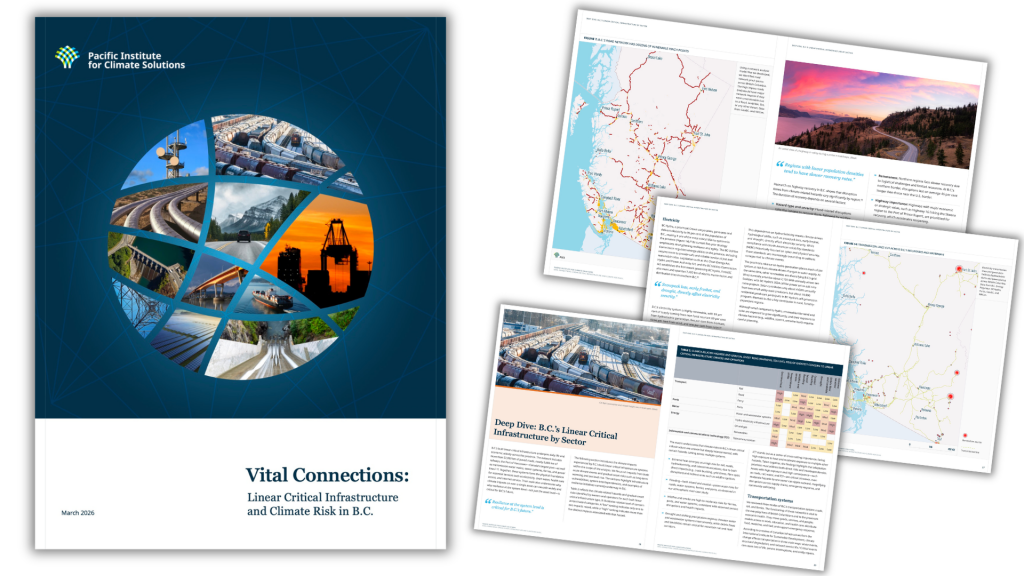
Vital Connections: Critical Infrastructure and Climate Risk
Experts discuss the risks and choices B.C. faces as its infrastructure is buffeted by a changing climate.
This report highlights practical ways governments and operators can better manage system-level infrastructure risk.

Shift from asset condition to service continuity.
Focus resilience planning and performance standards on keeping essential services operating under stress.

Improve visibility into system interdependencies.
Strengthen shared data and understanding of critical corridors, pinch points, and cross-sector dependencies.

Clarify coordination for system-level risk.
Ensure roles and decision-making are clear when infrastructure risks span sectors, owners, and jurisdictions.

Build public understanding and support.
Improve awareness of resilience trade-offs to support long-term planning and investment decisions.
PICS gratefully acknowledges the financial support of the Province of British Columbia through the Ministry of Emergency Management and Climate Readiness (EMCR).