Communities are facing more and more intense climate-related hazards, including wildfires, heat domes, and extreme precipitation. Common contemporary building materials may not be the most resilient or sustainable option. The building materials branch of the Rural & Remote Community Resilience project focuses on the potential of climate-resilient building materials and designs. Through sharing key information and examples about building materials and techniques from regions climatically similar to B.C.’s, we provide information to support building design and renovation decisions for communities facing climate-related hazards, including wildfires, heat domes, and extreme precipitation. The viewbook shares accessible information for a non-technical audience, particularly housing managers or planners in rural and remote communities, about climate-resilient building materials.
The materials used to build are just one part of a system that supports sustainable, resilient infrastructure. Building design, construction techniques, electrical systems, financing programs, and code regulations, among many other topics, are also part of the system, but are outside the scope of this webpage.
Not building something new?
Information on fire-resilient retrofits is included in our Community Fire Resilience Handbook. An introduction to retrofits that aid in moisture and seismic resilience can be found in our Introduction to Climate-Resilient Retrofits document.
About the Viewbook
Author
This page is part of the research project Building Climate Resilience in Rural & Remote Communities. The project is centred around collaborations that bridge climate strategies and policies in British Columbia with Indigenous and community-driven expertise. It focuses on low-carbon resilience in housing, technical systems, and community planning.
Acknowledgements
Building Climate Resilience in Rural & Remote Communities is funded through the Pacific Institute for Climate Solutions (PICS). Learn more about PICS and its work at climatesolutions.ca.
The project team would like to thank the following people for their guidance and support in completing this project:
- The many people we have had informal discussions with that helped to guide our direction and offered feedback along the way.
- Coral Buitenhuis & Marci McDougall, Technical Safety BC, for their support with directional & technical knowledge and databases that brought this work together.
- Connie Davis & Kear Porttris, First Nations Housing & Infrastructure Council, for their guidance and knowledge in governance and application.
- Niki Lindstrom (Saulteau First Nation; Director at Mistahiya Development Corporation) for her ongoing support and knowledge in bringing alternatives to Indigenous communities in British Columbia.
- Patrick Michell (Nlaka’pamux Nation Elder; former Rebuild Director for Lytton First Nation) for his willingness to share his perspective, guidance, and knowledge.
- Rod Hill, Magda Szpala, & Wilma Leung, BC Housing, whose endless knowledge and support for this work has helped to drive it forward.

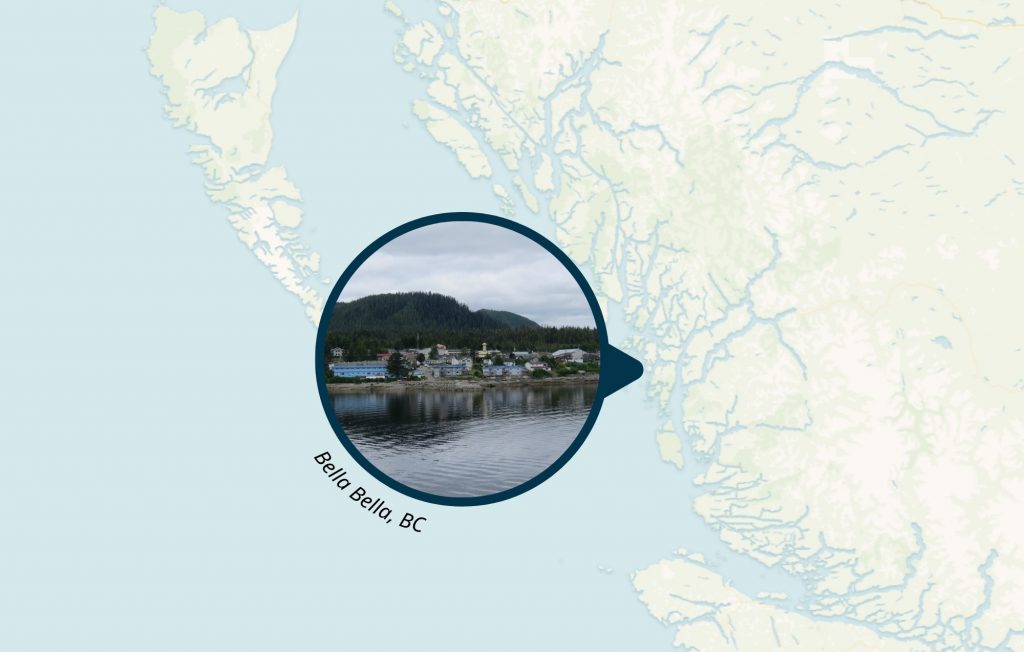
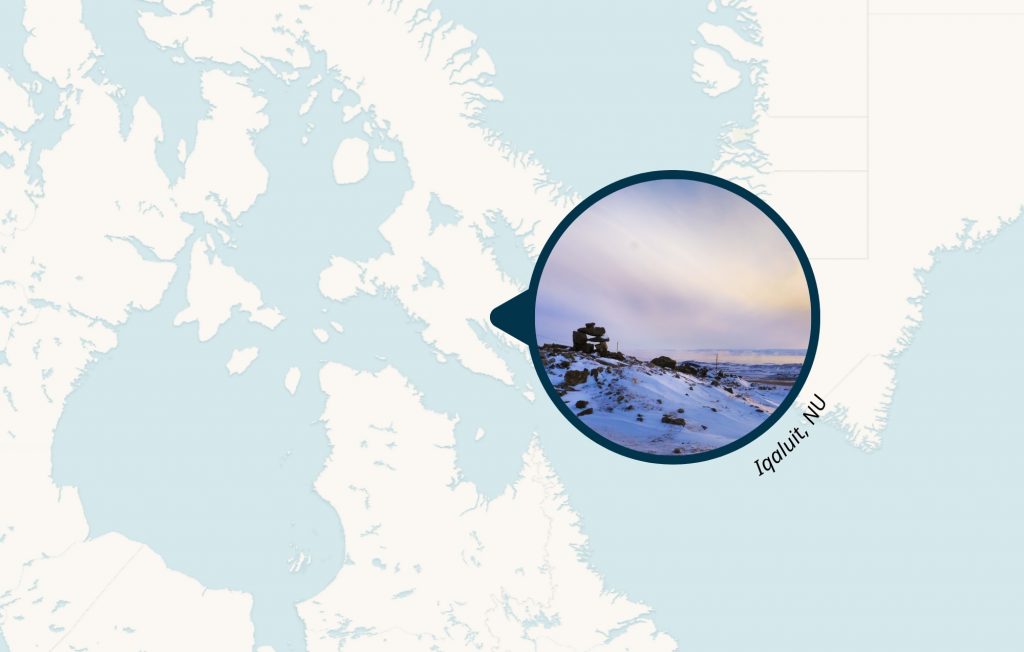
Map: Explore Climate-Resilient Building Materials by Region
Not all materials belong in all climates! Decisions about building materials involve assessments of cost, quality, and resilience to various hazards. Such decisions involve tradeoffs (e.g., between heat resilience and moisture resilience). B.C. is an ecologically diverse province, so what works in one area may not be suitable in another. The map and flowcharts are tools for preliminary decision-making about what materials may be suitable for a given climate, budget, and hazard.
Undertaking a climate risk assessment and/or consulting the Province of British Columbia’s disaster and climate risk and resilience maps may be helpful approaches to determine which hazards should be prioritised.
How to use this map:
When you click on a region, a sidebar with information about that region will appear. This sidebar shares:
- The name of the ecological region, as classified by the Government of B.C.
- Information about that region’s climate and common climate-related hazards.
- A link to a flow chart that outlines potential building materials that may be suitable.
Just want the flow chart?
Factsheets
Climate-Resilient Building Materials
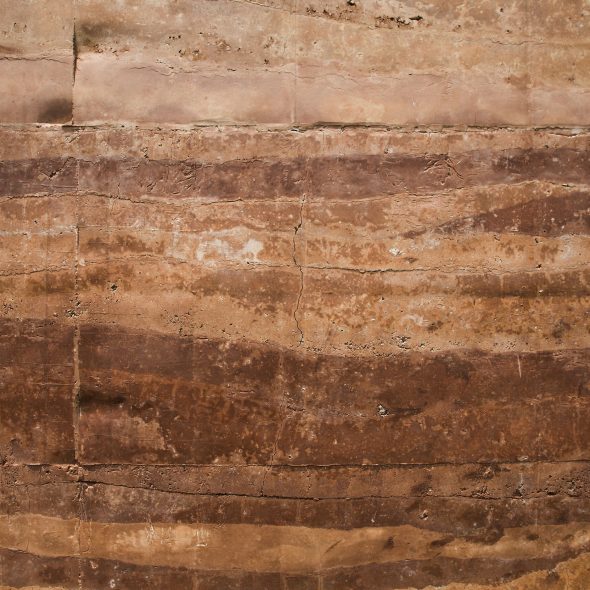
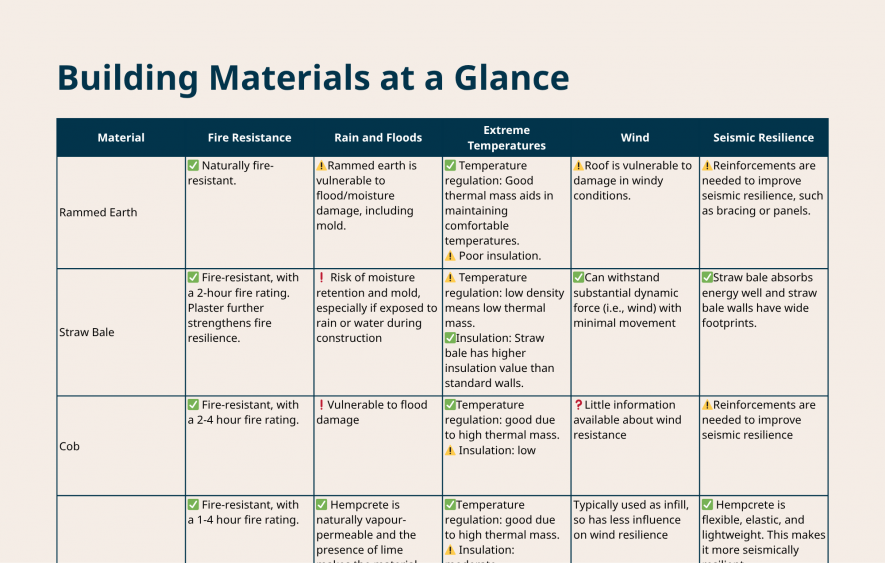
Rammed Earth
✅ Fire-resistant, erosion-resistant, and good thermal mass.
⚠️ Risk of moisture retention in humid climates, damage in floods or storms, and lacks insulation.
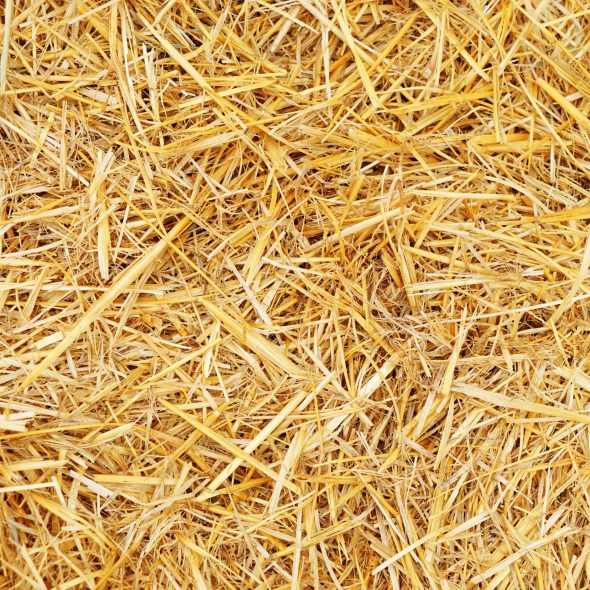
Straw Bale
✅ A fire-resistant material with good seismic resilience
⚠️ Substantial concerns with mold and lack of ventilation.
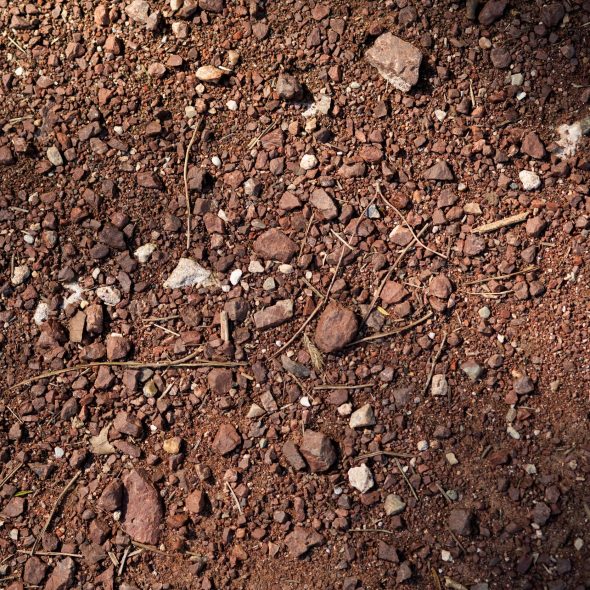
Cob
✅ A fire-resistant material that is often locally available, cost-effective, and beginner-friendly.
⚠️ Vulnerable to flood and earthquake damage if not properly reinforced.
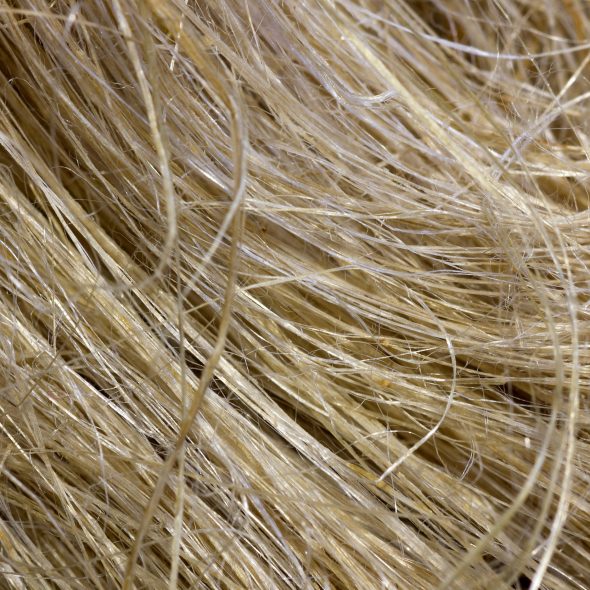
Hempcrete
✅ Resilient to wildfire, moisture, seismic activity, and pests.
⚠️ Low compressive strength limits application to insulation or infill.
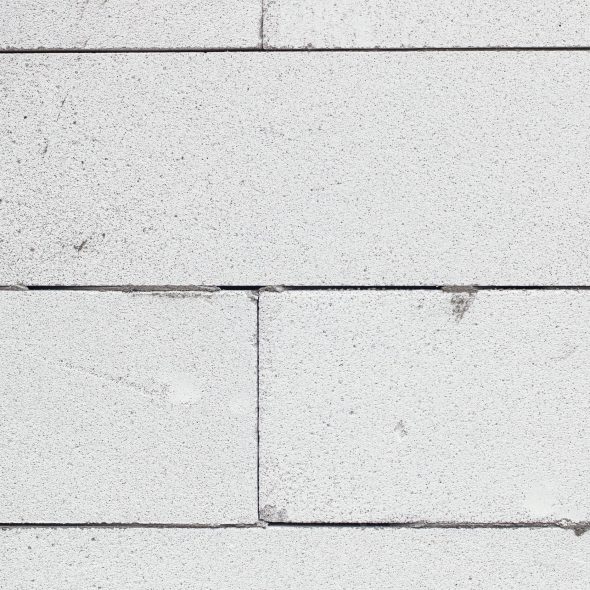
Autoclaved Aerated Concrete (AAC)
✅ Fire-resistant, breathable, and seismic-resilient.
⚠️ Modifications required for freeze-thaw resistance and limited domestic supply options.
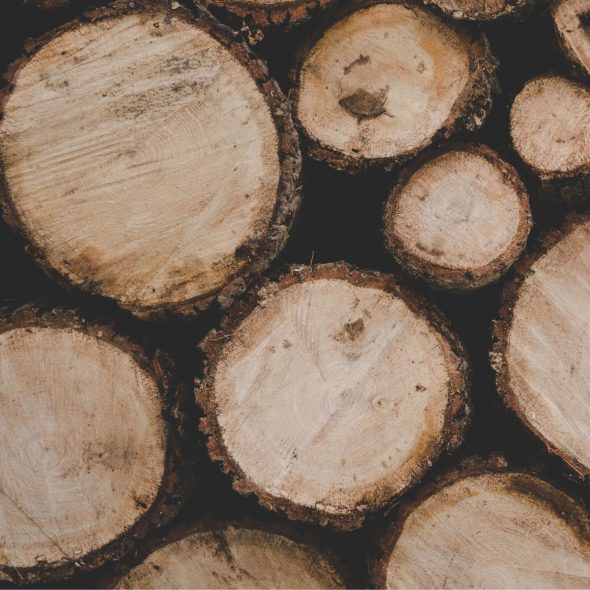
Mass Timber
✅ Fire-resistant, wind-resistant, and seismic-resilient.
⚠️ Needs moisture management. Moderate insulation.
Climate-Resilient Building Techniques
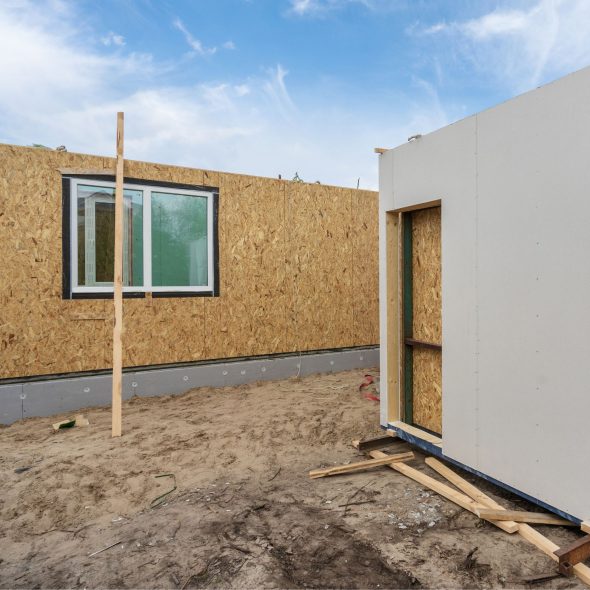
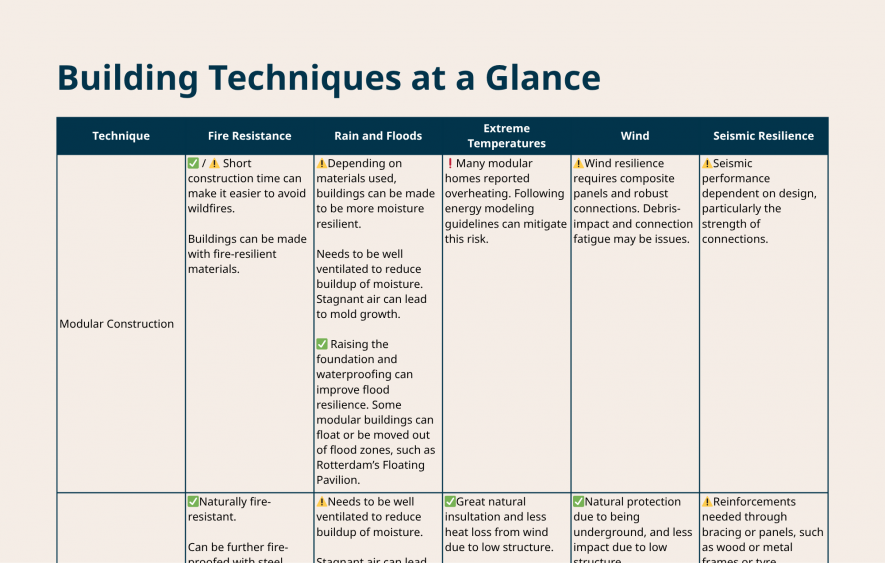
Modular Houses
✅Flexible option that can be built with moisture and fire-resilient materials. Relocateable.
⚠️ Risk of overheating. Quality is highly variable based on the materials used.
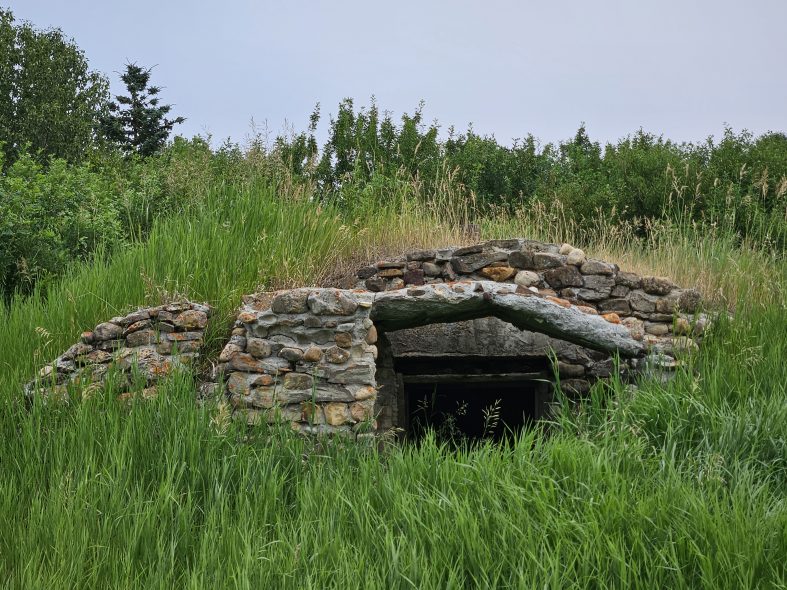
Pit Houses
✅Fire-resistant with excellent thermal insulation.
⚠️ Risk of overheating, mold, and poor air quality due to poor ventilation.
Rammed Earth
Background
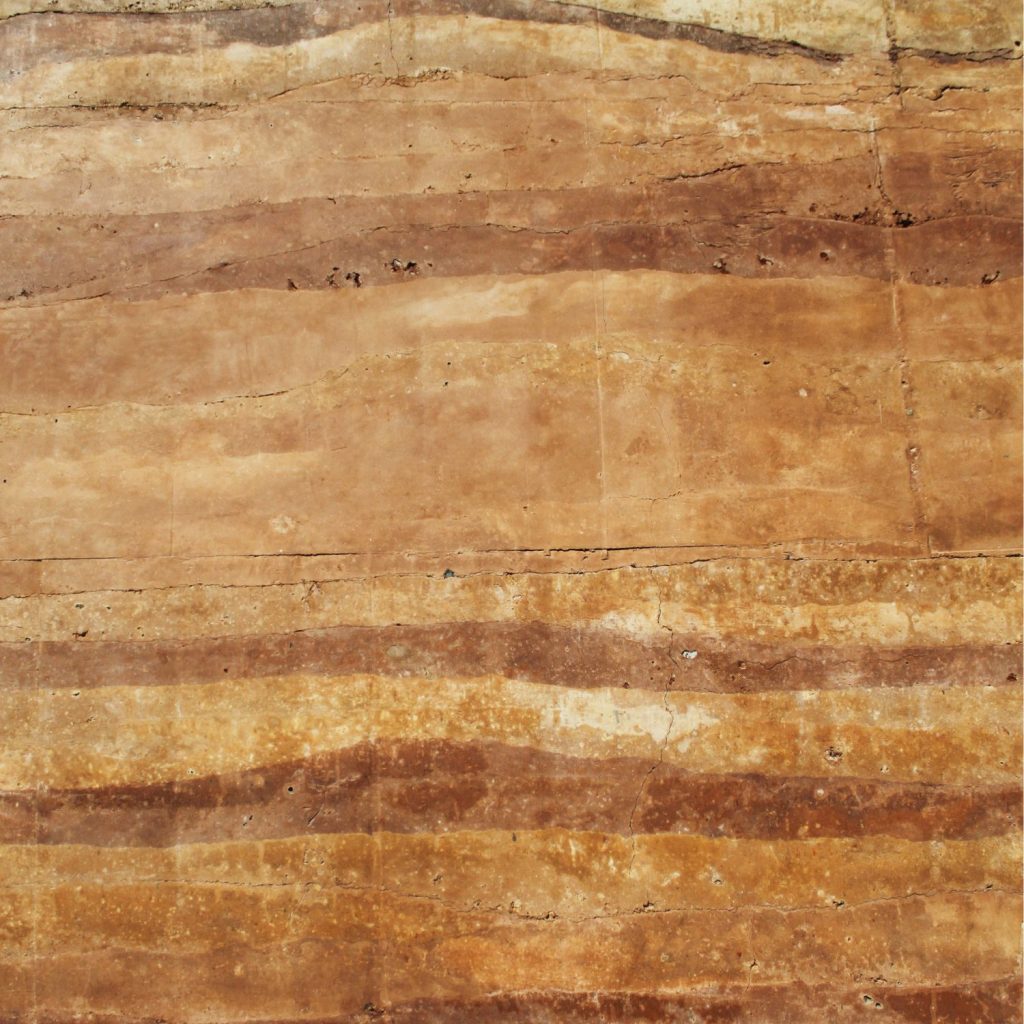
Building with rammed earth involves compressing earth – a mix of sand, gravel, and clay, often with stabilisers such as lime or cement – into vertical formworks* layer by layer. This approach produces strong, compact walls.
*Formworks are temporary wooden or plywood frames used to shape the wall.
Hazard Resilience of Rammed Earth
Fire ✅
Naturally fire-resistant, with a fire rating of up to four hours (meaning it can withstand fire for up to four hours).
Flooding & Moisture ⚠️
Rammed earth is vulnerable to flood/moisture damage. Sealing and drainage systems are needed.
If seals are inadequate, a raised design can reduce vulnerability to floods. However, rammed earth buildings are generally best for dry or temperate climates.
Wind ⚠️
Roof is vulnerable to damage.
Extreme Temperatures ✅
Good temperature regulation aids in natural heating and cooling.
Seismic ⚠️
Reinforcements are needed to improve seismic resilience, such as bracing or panels:
- Wood or metal frames (medium cost)
- Cross-bracing (medium cost)
- Tyre Foundations (earth-filled tires) below the walls (low cost)
Cost Estimates
Cost estimates for rammed earth vary depending on many factors, including site, soil type, and labour/transportation costs. innovative earth, a company based in Alberta, Canada, estimates rammed earth construction costs $250-350 per square foot (estimate accessed in 2025).
Generally, costs for rammed earth are likely to be higher upfront compared to conventional materials, with a long-term return because of its sustainability.
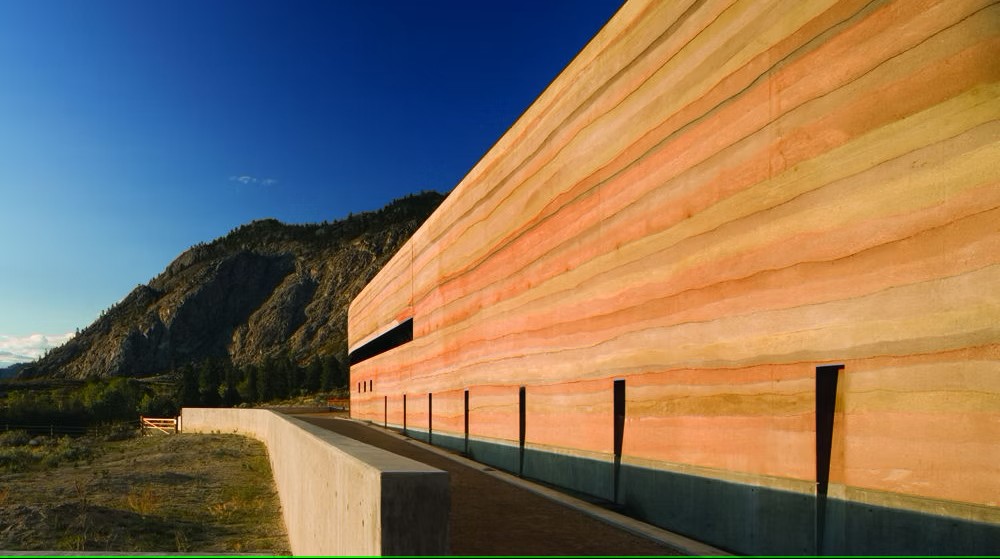
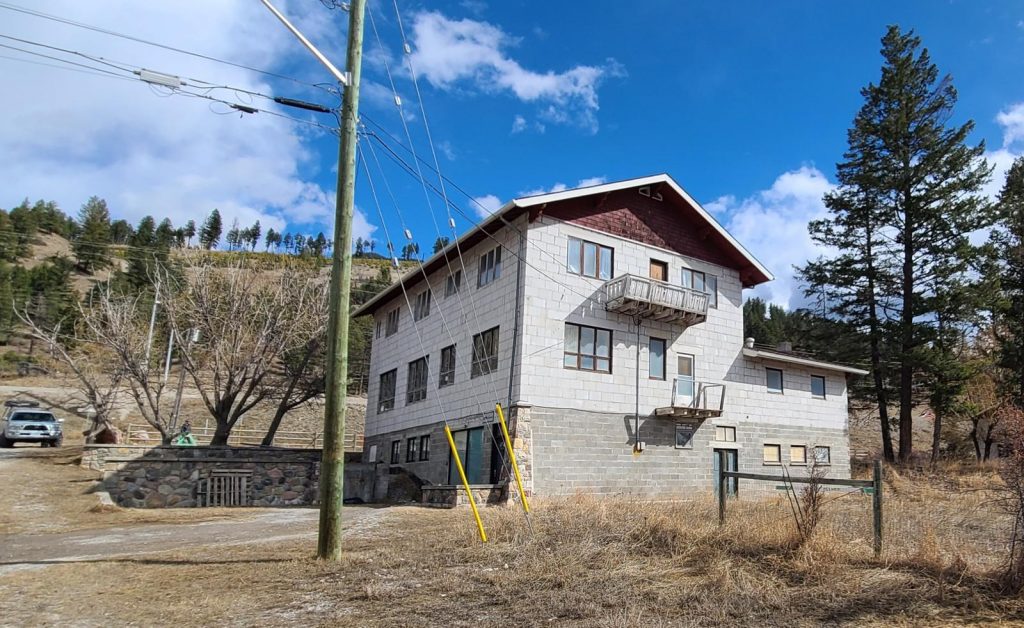
Examples of Rammed Earth Construction
Straw Bale
Background
Straw is a grain stalk (such as wheat, rice, rye, or oats) without the head. Straw-bale can be used as infill for post and beam/timber framing walls. Straw can also be compressed into agriboard or blocks.
Hazard Resilience of Straw Bale
Fire ✅
Although straw is combustible, straw bale has a 2-hour fire rating, which means it can withstand fire for about two hours before it is destroyed. This is twice as fire resilient compared to frame walls. The compression of straw into blocks minimises oxygen, limiting combustion potential. Plaster can further strengthen fire resistance.
Flooding & Moisture ‼️
Straw bales must be waterproof and breathable. Moisture levels should be below 15% (ideally 10%), and levels above 20% can lead to rot. Load capacity is also reduced under high moisture.
High moisture or lack of ventilation can lead to mold. Straw bale should be kept 2-3 feet above the ground to prevent moisture from seeping upwards.
Wind ✅
Straw bale walls can withstand substantial dynamic force with minimal movement (see the BaleHaus@Bath case study for more detail).
Extreme Temperatures ✅
Straw bale has higher insulation value than standard walls filled with fiberglass, cellulose, or rock wool. However, straw bale has low thermal mass.
Seismic ✅
Straw bale absorbs energy well and straw bale walls have wide footprints. Both these attributes make straw bale seismic-resilient. A study from the University of Nevada showed straw bale was able to withstand 200% greater shakes than a simulated 6.7 magnitude earthquake.
Cost Analysis
Costs
For a straw bale wall, costs are estimated at $180-208 per square foot (number based on an American website accessed in 2025). This does not include components other than the straw bale, such as the foundation, roof, doors, windows, and plumbing.
Straw bale is generally more affordable and beginner-friendly to work with compared to other materials. However, as with all other building projects, actual costs will vary based on many regional and site-specific factors.
Examples of Straw Bale Construction
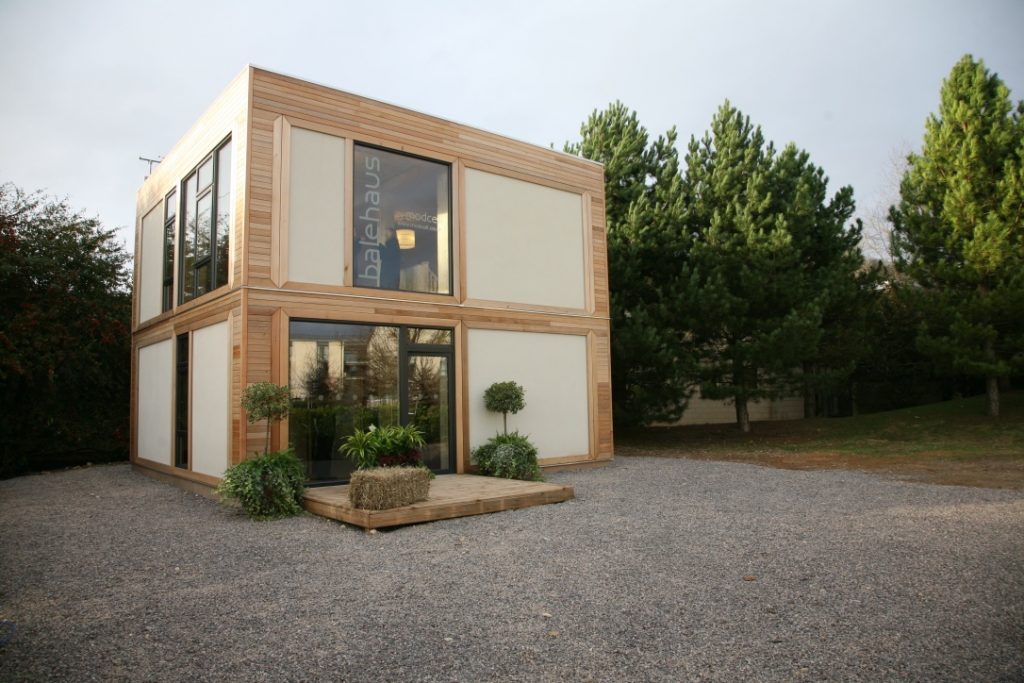
Photo credit: Agile Property and Homes Ltd and ModCell.
Cob
Background
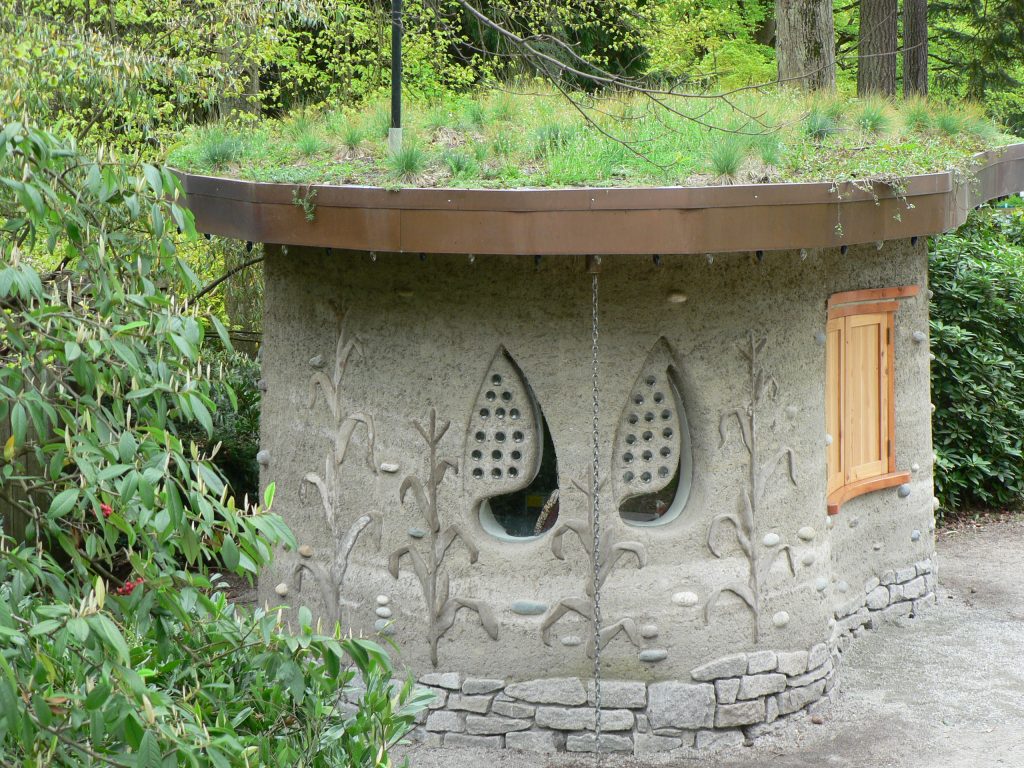
Cob consists of clay, straw, sand, lime and water, which is mixed and becomes stiff when cured. The final product resembles a form of concrete. While the material can be load bearing for single story/low-rise structures, it is typically used as infill for timber post and beam walls.
Hazard Resilience of Cob
Fire ✅
Cob is fire-resistant and can withstand fire exposure for 2-4 hours.
Flooding & Moisture ‼️
Cob is vulnerable to flood damage.
Wind ❓
Little information available about wind resistance
Extreme Temperatures ✅
High thermal mass but poor insulation.
Seismic ⚠️
Cob needs reinforcements for seismic resilience.
Cost Analysis
As of 2025, recent and credible public estimates of costs were not available. Estimates may be available through local suppliers. Generally, cob is made with relatively low-cost materials but is labour-intensive to work with.
Examples of Cob Construction
Hempcrete
Background
Hempcrete is composed of the dried woody cores of hemp fibers, lime, and water. While some innovative load-bearing applications are being explored, the material is best suited as insulation or infill for walls.
Hazard Resilience of Hempcrete
Fire ✅
Hempcrete can withstand 1+ hours of fire exposure depending on the thickness of the wall (about 1 hour per 4 inches of thickness).
Flooding & Moisture ✅
Hempcrete is naturally vapour-permeable and the presence of lime makes the material more resilient to moisture and mould.
Wind: n/a
Typically used as infill, so has less influence on wind resilience.
Extreme Temperatures: ✅
Moderate insulation and high thermal mass. These qualities mean hempcrete can stabilize indoor temperatures and slowly absorb and release heat, which moderates temperature swings.
Seismic ✅
Hempcrete is flexible, elastic, and lightweight. This makes it more seismically resilient.
Cost Analysis
As of 2025, recent and credible public estimates of costs were not available. Estimates may be available through local suppliers. Hempcrete may be more expensive than standard infill options.
Autoclaved Aerated Concrete (AAC)
Background
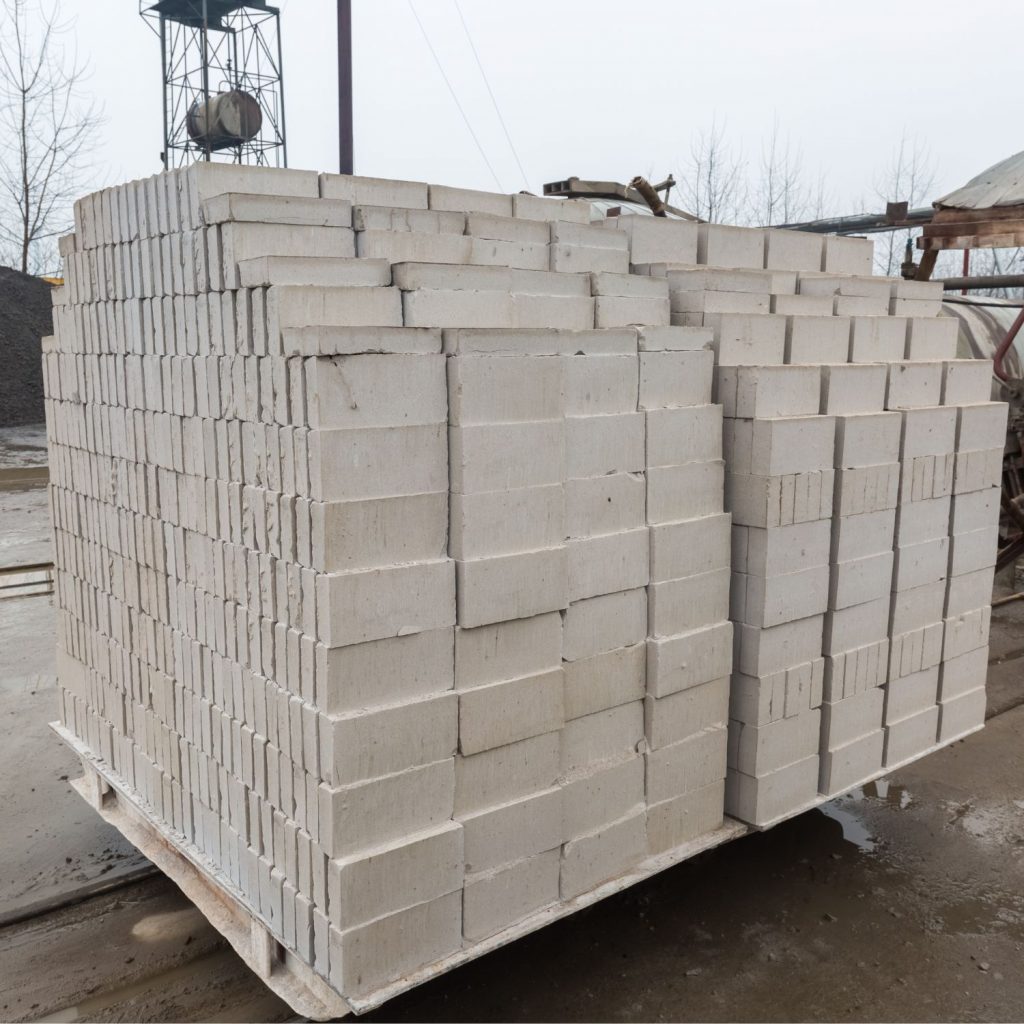
Autoclaved aerated concrete (AAC) is a mineral-based building material made from sand, water, limestone, cement, and aluminum powder. The mixture is then hardened in an autoclave (pressurized steam chamber). It is a lightweight form of concrete best used as cladding to provide a protective exterior for new and existing buildings. AAC can also be used for low to mid-rise load-bearing walls.
Although AAC has many benefits as a climate-resilient, pest-resistant material, limited supply options and specialised training requirements have constrained its use in British Columbia.
Hazard Resilience of AAC
Fire ✅
- High hourly fire rating, which means AAC can withstand fire for a long period before damage.
- Good thermal insulation.
Moisture & Flooding ⚠️
- Inorganic and breathable, making it resistant to mould growth.
- A waterproof but vapor-permeable exterior coating may be required in moist climates / flood-prone conditions.
Wind ⚠️
Needs reinforcements for wind resistance, such as reinforced vertical, grout-filled cores and bond beams.
Extreme Temperatures ✅
- Excellent insulation.
- However, freeze-thaw resistance requires an exterior coating, which could interfere with the breathability of the material.
- A waterproof but vapor permeable coating that allows for dissipation of moisture is recommended.
Seismic ✅
The relatively high compressive strength and light weight of AAC blocks contributes to seismic resilience.
Cost Analysis
As of 2025, recent and credible public estimates of costs were not available. Estimates may be available through local suppliers. The upfront cost of AAC may be higher than conventional concrete but its lightweight nature makes it more affordable to construct with.
Geographic variance:
Costs may vary due to higher transportation costs as there are a limited number of AAC block supplies in Canada.
Mass Timber
Background
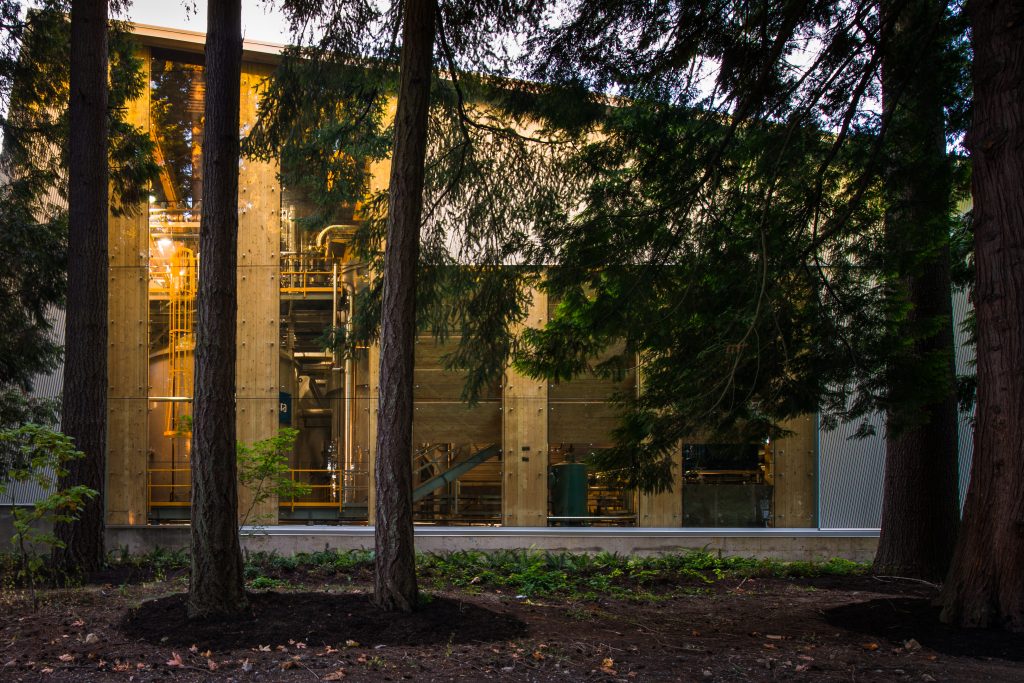
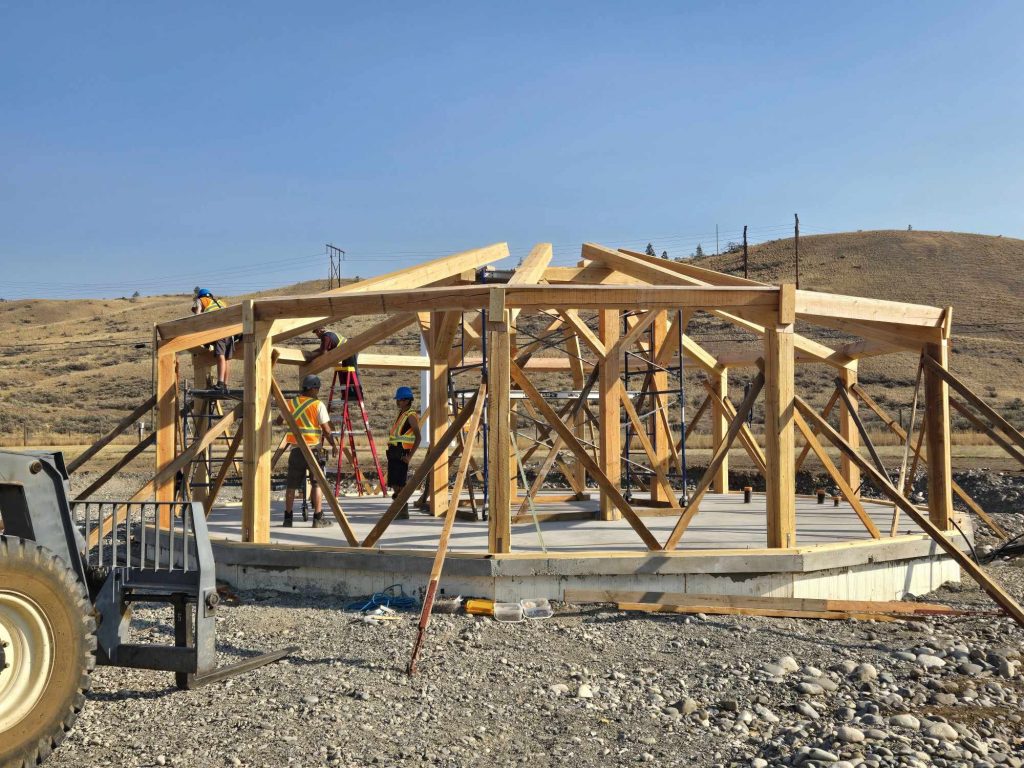
Mass timber construction uses engineered wood products, such as cross-laminated timber (CLT), glulam, and nail-laminated timber (NLT), which are formed by bonding layers of wood with adhesives or fasteners. Panels and beams are manufactured off-site for strength and speed, then assembled on location for tall buildings and other structures. This method offers significant environmental benefits, strong structural performance, and efficient construction. However, like other lumber products, mass timber is vulnerable to moisture damage and pest infestation.
Photo Credit: Don Erhardt, courtesy naturallywood.com
Background
Mass timber construction uses engineered wood products, such as cross-laminated timber (CLT), glulam, and nail-laminated timber (NLT), which are formed by bonding layers of wood with adhesives or fasteners. Panels and beams are manufactured off-site for strength and speed, then assembled on location for tall buildings and other structures. This method offers significant environmental benefits, strong structural performance, and efficient construction. However, like other lumber products, mass timber is vulnerable to moisture damage and pest infestation.
Hazard Resilience of Mass Timber
Fire ✅
- Fire resistant, as surface char forms a protective layer.
- Fire rating of 3+ hours.
- Depending on the extent and degree of fire damage, post-fire repair may be intensive and expensive.
Moisture & Flooding ⚠️
- Moisture management is needed.
- Risk of swelling or decay without protective detailing.
Wind ✅
Strong wind resistance because engineered connections provide stability.
Extreme Temperatures ✅
Moderate insulation and high thermal mass
Seismic ✅
Flexibility and engineered joints help withstand earthquakes.
Cost Analysis
Cost estimates for mass timber construction can vary by region, design, and supply factors. In British Columbia, current quoted costs for mass timber systems are in the range of $400–$450 per square foot, influenced by demand, manufacturing capacity, and regulatory support. Prefabrication reduces construction time and labor, while local sourcing supports regional economies. Upfront costs can be higher than conventional concrete but may be offset by speed and sustainability incentives.
Mass Timber Resources
The Province of British Columbia has made significant investments into mass timber engineering, construction, and projects. Exemplar projects, case studies, research, and information about suppliers are available through the Mass Timber Demonstration Program’s website.
How do these materials compare to conventional concrete?
Background
Conventional concrete combines cement, aggregate, water, and supplementary cementitious materials such as fly ash, slag, or recycled aggregate. It remains the dominant material for foundations, floors, and walls in B.C. due to its structural strength, versatility, and local availability. Recent innovations include low-carbon cements and advanced admixtures that enhance resilience and reduce emissions. Concrete may be site-poured or precast to lower waste and speed assembly.
Hazard Resilience of Concrete
Fire ✅
- Non-combustible with typical 2–4 hour fire ratings, maintaining strength at high temperatures.
- Widely used for fire-resistant building envelopes.
Moisture & Flooding ⚠️
- Highly water resistant, inorganic, and mold-resistant.
- Susceptible to freeze–thaw surface degradation. Proper mix design and protective coatings are essential in B.C.’s coastal and northern climates.
- Prolonged exposure can cause surface damage without sealing. Exterior coatings mitigate deterioration.
Wind ✅
Dense, rigid, and capable of withstanding high wind pressures, particularly when steel-reinforced. Common for coastal and high-rise structures in B.C..
Extreme Temperatures ⚠️
Excellent thermal mass stabilizes indoor temperature and reduces energy loads. However, low R-value (0.1–0.2 per inch) means additional insulation is required. Freeze–thaw cycles may impact durability without protective detailing.
Seismic ⚠️
Reinforcements with steel needed for seismic performance. Retrofitting can enhance older structures.
Why consider alternatives to conventional concrete?
While cement is widely available, strong, and generally reliable, cement production is emissions-intensive and globally accounts for about 7% of greenhouse gas emissions. Although lower-emissions processes are being developed, many other building materials, like straw bale and cob, are much more environmentally friendly. While cement is fire-resistant, some of the alternatives (such as AAC) have higher fire ratings. Furthermore, concrete tends to be very heavy, requiring heavy-duty and expensive equipment to construct with. Many alternative building materials are easier to work with, even for novice builders.
Modular Houses
Background
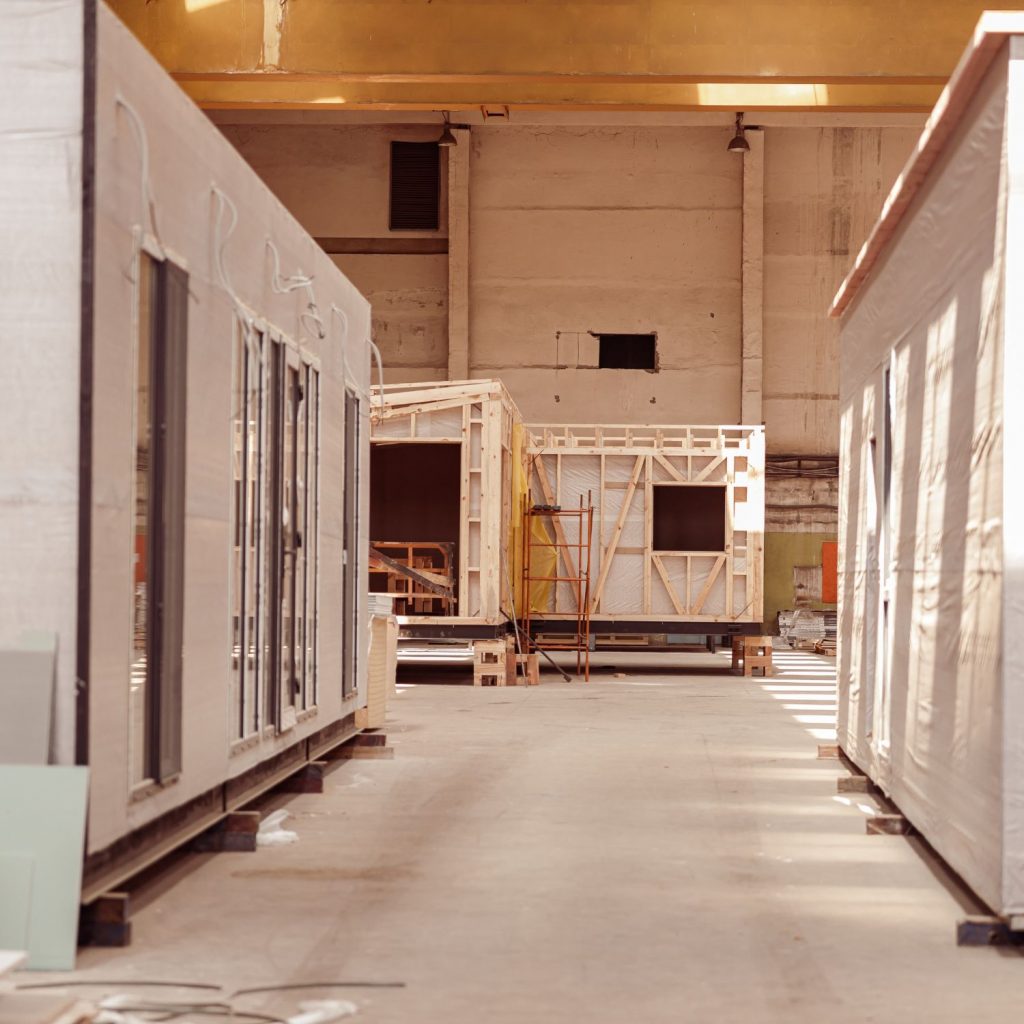
B.C. faces a growing housing supply and affordability gap. Communities are searching for solutions to accelerate the construction of new housing. Modular housing is a construction method that uses building modules that are built in-factory, then combined on-site. This method requires less on-site construction labour, which can speed up the construction process.
The adoption of modular buildings is still relatively new in B.C., and research on whether modular buildings are resilient to the effects of climate change is needed. However, the advantage of quick on-site construction provides several benefits for communities that experience short construction seasons and need quick and effective solutions to rebuild after extreme climate hazard events.
Hazard Resilience of Modular Houses
Fire ✅ / ⚠️
- Short construction time can make it easier to avoid wildfires.
- Buildings can be made with fire-resilient materials.
Moisture ✅ / ⚠️
- Depending on materials used, buildings can be made to be more moisture resilient.
- Needs to be well ventilated to reduce buildup of moisture. Stagnant air can lead to mold growth.
Wind ⚠️
Performance depends on strength of connections.
Extreme Temperatures ⚠️
Many modular homes reported overheating, so energy modeling guidelines are important to follow. Heat loss and overheating depend on exterior insulation.
Seismic ⚠️
Mixed seismic performance depending on design
Information Gap: Climate Adaptations
How can modular buildings be adapted for different climates? Information and tangible examples about adaptations would be helpful.
Examples of Modular Construction
Modular construction is increasingly used to construct energy-efficient, affordable housing.
Pit Houses
Background
Pit houses are partially built into the ground. They historically provided warmth and shelter during the winter season for various Indigenous peoples in the Plateau region. While they are no longer common dwellings, they remain culturally important.
Hazard Resilience of Pit Houses
Fire ✅
- Naturally fire-resistant.
- Can be further fire-proofed with steel roofing.
Moisture & Flooding ⚠️
- Needs to be well ventilated to reduce buildup of moisture.
- Stagnant air can lead to mold growth.
- Flooding can occur due to low structure (exact location of the house is important).
Wind ✅
Natural protection due to being underground and less affected by wind due to low structure. Resilient to high winds, hailstorms, and natural disasters such as hurricanes.
Extreme Temperatures ✅
- Great natural insulation and less heat loss from wind due to low structure.
- For low to medium cost, roof overhangs or insulation (reflective roofing) can be added.
Seismic ⚠️
Reinforcements needed through bracing or panels, such as wood or metal frames or tyre foundations (earth-filled tires) below the walls.
Information Gap: Extreme Weather
It is unclear how effective pit houses are in different climates, and how resilient they are in extreme weather situations.
Cost Analysis
Recent information about the cost of construction pit houses in similar climates as B.C.’s is unavailable. Estimates may be available through local suppliers.
The form and material of pit houses (and other forms of earth-sheltered housing) varies greatly, and initial costs of construction can be greater than a conventional house.
Geographic variance:
Costs may vary due to higher transportation costs in remote and special access areas. In Coastal B.C. communities with more moisture, the need for increased moisture barriers would increase costs. Northern B.C. villages would require extra insulation to address extreme cold temperatures, which would increase costs as well. Pit houses may be better suited for rural Indigenous areas where there is room for excavation and better soil suitability compared to urban areas. They are particularly cost-effective in climates with low humidity (reducing risk of damage from moisture) and temperature extremes, as the earth’s temperature will vary much less than air temperatures, maintaining comfortable temperatures within the home.
Example of Modern Construction Inspired by Pit Houses
Other Resources & Sources Related to Climate-Resilient Building
Information about the sources used to compile the information on this page is at the end of the complete building materials viewbook.
Climate-Resilient Materials for the Built Environment
2050 Materials (company that compares building material information)
This short article explains the taxonomy of climate-resilient materials. It provides information on materials for structural resilience, facades, insulation, and water-proofing. The table (Exhibit 8) also provides information about the maturity of each technology and their climate hazard resilience.
Codifying Climate Resilience
Building Rural & Remote Community Climate Resilience Project
This is a companion PDF that provides background information on building codes in British Columbia. It outlines the current barriers to codifying climate and disaster resilience in building codes, then proposes future steps to address these challenges.
An Introduction to Climate-Resilient Retrofits
Building Rural & Remote Community Climate Resilience Project
This companion PDF provides introductory information on how to make structures more climate-resilient through retrofits. It provides options at different relative price points to improve a structure’s moisture and seismic resilience.