Climate research grants support First Nations led and codesigned projects
The PICS World Weaving Climate Research Program supports First Nations led and co-designed climate research, and associated relationship building and knowledge exchange. Grounded in the principles of the Relationship Protocol between PICS and the First Nations Leadership Council, the program offers three granting pathways designed to ensure research partnerships are built on respect, reciprocity, and meaningful First Nations leadership.
The program is designed to strengthen research and capacity in alignment with the BC First Nations Climate Strategy and Action Plan and the Action Plan for Disaster Risk Reduction by BC First Nations.
World weaving is the practice of intentionally creating connections across different knowledge systems, lived experiences, and ways of understanding the world. Rather than prioritizing one way of knowing over another, world weaving holds space for multiple truths to coexist, fostering collaboration that is more equitable, grounded, and responsive to community priorities.
Recognizing that strong climate solutions emerge from both trusted relationships and sustained collaboration, the granting pathways support work at different stages of the research process. From building relationships and sharing knowledge, to advancing longer-term research on complex climate challenges, these funding opportunities are designed to strengthen partnerships, support community priorities, and contribute to building holistic climate resilience.
The three granting pathways are:
- Relationship Building (RBP)
- Knowledge Exchange (KEX)
- World Weaving Multi-Year Research
Our Granting Pathways
Relational Foundations Grants
Relational Foundations grants support the relational and collaborative processes that make ethical and effective climate research possible. Grants are available for activities that strengthen relationships between First Nations and research partners, support reciprocal knowledge exchange and mobilization, and enable meaningful First Nations leadership and co-design throughout the research process.
These pathways recognize relationship-building and knowledge exchange are essential foundations for ethical and effective climate research.
Funding is available through the following two pathways:
PATHWAY 1: Relationship Building Pathway (RBP)
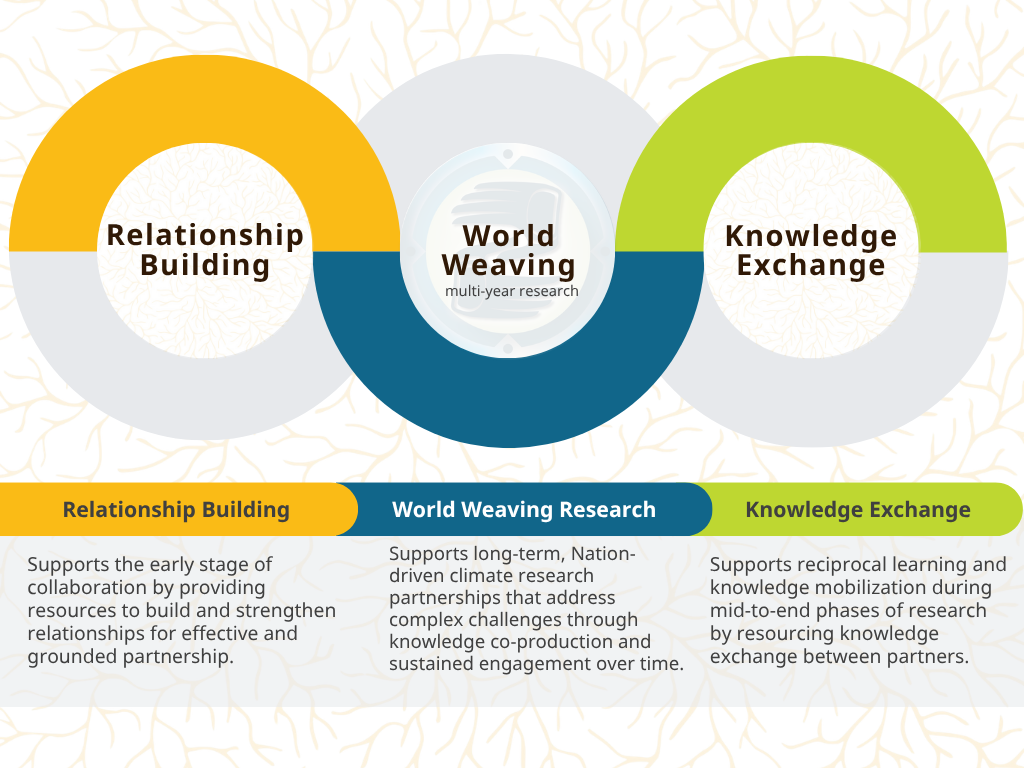
Supports the early stage relational groundwork needed to build or deepen partnerships between communities and researchers. Funding focuses on strengthening trust and collaboration, and establishing shared priorities.
PATHWAY 2: Knowledge Exchange Pathway (KEX)
Supports exchange and mobilization of knowledge during the mid-to-end stages of climate research when findings are being shared, implemented, or brought into practice.
PATHWAY 3: World Weaving Multi-Year Research Pathway
The World Weaving Multi-year Research Pathway supports long-term climate research that addresses complex and emerging climate challenges facing First Nations communities. This pathway aims to advance Nation-led climate priorities, ethical and relational research practice, and knowledge co-production, by supporting sustained and relevant climate research that cannot be meaningfully achieved within short funding cycles.
Projects supported through this pathway:
- address complex, systemic, or emerging climate issues;
- are grounded in meaningful First Nations leadership and co-design;
- strengthen governance, relationships, and collaborative capacity over time; and
- support long-term knowledge mobilization and community decision-making.
The pathway provides funding to enable sustained, impactful research partnerships.

Which Pathway is right for you?
Our granting pathways support different stages of collaborative climate research. The illustration below can help you determine which pathway best fits your project. Please refer to the details provided in granting pages for more information.
The PICS and First Nations Leadership Council Relationship Protocol
The First Nations Leadership Council (FNLC) and the Pacific Institute for Climate Solutions have entered into a Relationship Protocol to advance First Nations climate leadership and priorities, and to generate benefits for First Nations in British Columbia.
With this protocol, the FNLC and PICS aim to support the implementation of the BC First Nations Climate Strategy and Action Plan and Action Plan for Disaster Risk Reduction by First Nations in BC. These frameworks present a strong vision for First Nations-led climate action to support current and future generations in achieving self-determination to care for the Earth and ensure health and stability in the face of the ongoing human-made climate crisis.