By: Zoe Leech
First Nations across what is now known as British Columbia face intersecting climate risks: flooding, fires, rising ocean temperature, infrastructure strain, and food insecurity (Gifford et al. 2022). These risks come from long-standing cumulative effects of federally and provincially approved development which have altered hydrological systems, constrained land-use options, and reduced ecological resilience (Ignace 2025; Efford et al. 2025).
From my perspective these outcomes are closely tied to the systematic exclusion of Indigenous governance systems from federal and provincial policy and decision-making. For millennia, Indigenous Nations have governed and stewarded their territories in ways that have supported ecological balance and long-term resilience (Dick et al. 2022). The scale and intensity of climate-related impacts may reflect the consequences of colonial governance frameworks that prioritize extractive development. This knowledge highlight intends to underscore the importance of reintegrating Indigenous stewardship practices that are shaped by cultural and spiritual knowledge systems into climate decision-making through my work with Kitasoo Xai’xais Nation.
I intend to demonstrate how Indigenous leadership and cultural and spiritual practices, like reciprocity, are key to mobilizing climate adaptation and mitigation through a values-based case study of the Kitasoo Xai’xais Nation’s approach to stewarding their territory. The research I am co-developing with the Kitasoo Xai’xais Nation supports Indigenous-led climate planning, capacity building, and resilience. My hope is that through this document I may share transferable learnings for other First Nations and practitioners in B.C. seeking to protect their territories through asserting their traditional and modern stewardship practices.
background
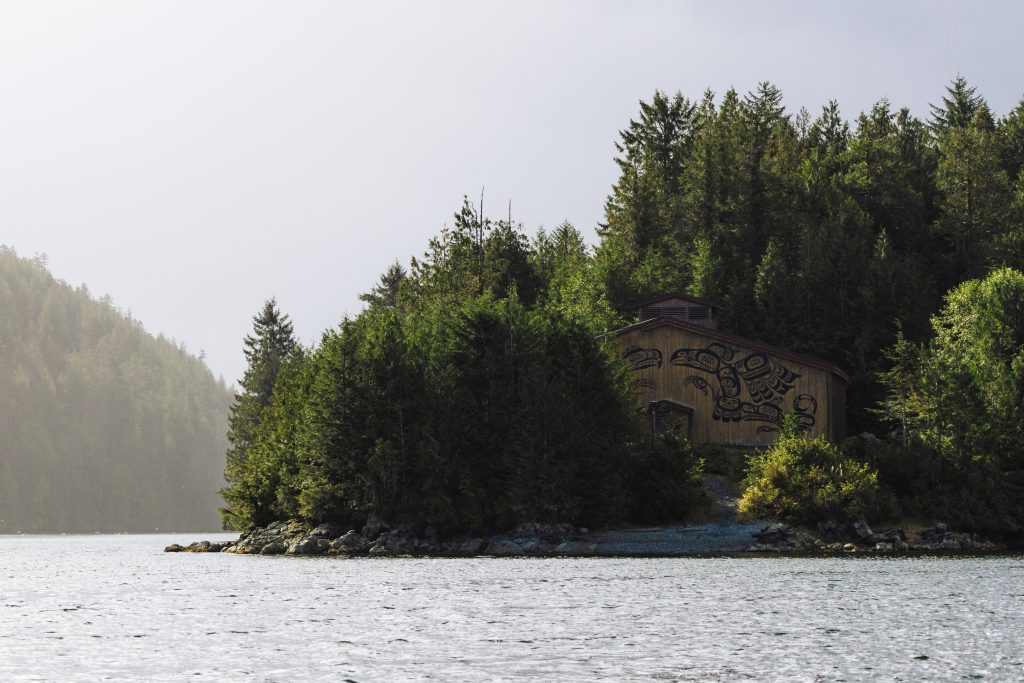
Invited by the Kitasoo Xai’xais stewardship authority, I have spent the better half of a year in Klemtu, in the heart of the Great Bear Rainforest, as a researcher, employee and guest. My role as a researcher involved facilitating the co-creation of a cultural monitoring tool with the stewardship authority while simultaneously supporting the Guardian Watchmen program. As a guest living in the community for 6 months, I was grateful to join community gatherings, feasts and ceremonies. Outside of this research project the Kitasoo Xai’xais Nation has developed a draft Community Energy and Emissions Plan which reflects the cultural, spiritual and governance principles that guide their marine stewardship, and applies them to energy sovereignty, infrastructure resilience, and climate mitigation. Together, their climate action plan and their stewardship of Indigenous Marine Protected Areas (IMPAs) demonstrate how Kitasoo Xai’xais governance operates holistically for successful stewardship of land, sea, energy and community well-being.
personal statement
My relationship to this research begins with my ancestral connections to the land through my maternal Grandmother, Inga Balogh, who was born in Hannover, Germany. She married my late Grandfather, Charlie Balogh, who was born in Hungary. And through my late paternal Grandmother, Donna Dickenson, who was born in T’it’q’et in the St’a’timc Nation. She met my late Grandfather James Richard Allen in Lillooet, who was Cree. My positionality and axiology come from the strength and capacity to love that my family has endured despite colonially imposed harm. From this spirit, I feel an obligation that flows from my heart to my mind, to my hands to work with Indigenous ontologies and epistemologies that have been passed down since time immemorial and shared by generous knowledge holders for the benefit of all. This thesis is born as part of my own healing journey, to be, before claiming to be, Indigenous.
research overview
This research is titled, “Sacred Waters: A Decolonial Global Literature Review on Spiritual and Cultural Considerations in Marine Protected Areas and a case study on Kitasoo Xai’xais Stewardship Practices in Indigenous Marine Protected Area Management”. The Kitasoo Xai’xais Nation have declared their own IMPA, Gitdisju Leyguks, known to settlers as Kitasu Bay, which is managed by Kitasoo Xai’xais traditional stewardship practices braided with western science. Gitdisju Leyguks is the first of many IMPAs that will be declared in March 2026 in conjunction with the planned National Marine Conservation Area Reserve. In my perspective, Indigenous cultural and spiritual stewardship practices have the power to transform conservation policy. By working with the Kitasoo Xai’xais Nation, my research will support the implementation of their priorities to better understand and document achieving successful marine protection through their governance.

Key Objectives
Culture is the invisible force that guides our relationships, to the land, each other, the creatures, and the supernatural. When a culture is healthy people care about long-term, sustainable outcomes and people feel valued, challenged, and connected to a purpose greater than themselves (Yunkaporta and Shillingsworth 2020). I was taught by my elders and mentors that spirituality comes from the relationship we have with our own spirit, which recognizes the spirit of all things, human and non-human. Spirituality isn’t a culture, but it is our beliefs, thoughts, and actions about the world around us that can be spiritual. In the peer-reviewed global literature review I conducted, when spirituality was included in cultural considerations of management, it had positive effects ecologically, socio-economically and in human well-being (Beaty et al. 2024; Kikiloi et al. 2017; Ban and Frid 2018; Baker et al. 2023).
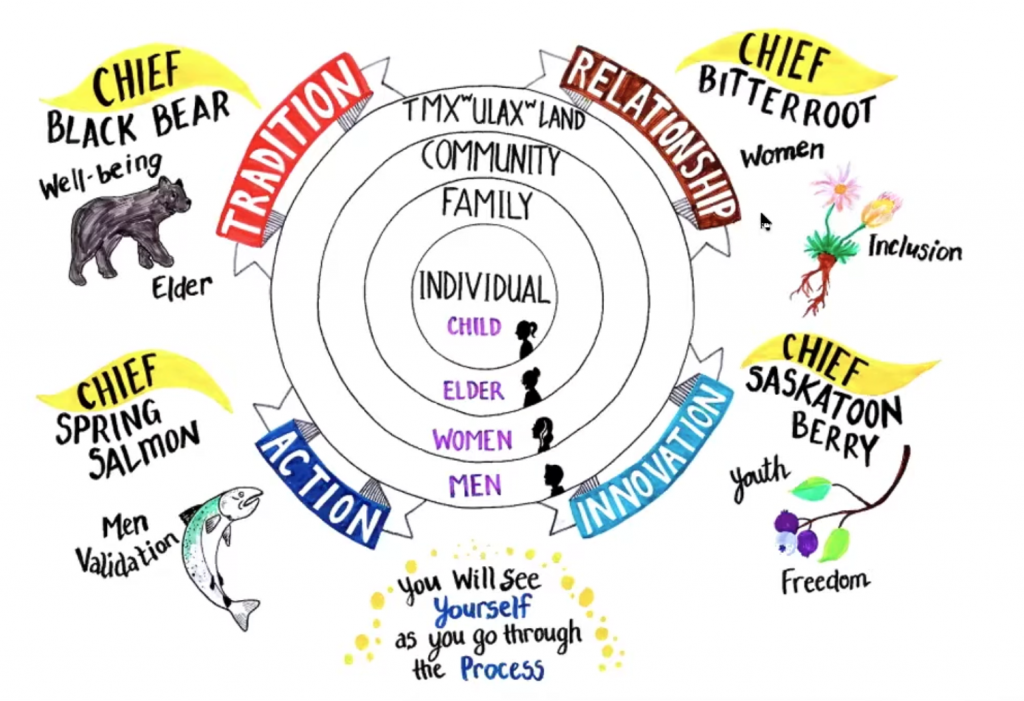
The primary objective of this research is respectfully documenting how Kitasoo Xai’xais culture and spirituality are vital to ensuring successful marine conservation outcomes and community well-being. Figure 1 is provided as a visual that shows how Indigenous culture and spirituality is interconnected through healthy relationships to ecosystems and community.
Reciprocal research &
Co-development practices
This research is part of a long-standing reciprocal relationship grounded in trust, continuity, and accountability that Dr. Natalie Ban began with the Kitasoo Xai’xais Nation over a decade ago. To ensure that this project was responsive to Kitasoo Xai’xais stewardship priorities rather than a predefined academic agenda we started relationship building through preliminary meetings. Guided by what the stewardship authority identified as useful and timely, I began with a global decolonial literature review of cultural and spiritual aspects of marine protected areas. The literature review is decolonial by privileging Indigenous Knowledge systems to support the Kitasoo Xai’xais Nation in their development of IMPAs and Indigenous Protected Conserved Areas (IPCAs) in their territory.
Further meetings with Kitasoo Xai’xais Stewardship Authority (KXSA), following good practices, determined the usefulness of developing a cultural monitoring tool. In Canada, Indigenous Nations are often forced into ecological monitoring because colonial systems demand evidence through Western science (Augustine and Dearden 2014). Cultural monitoring is a way to demonstrate Indigenous ways of knowing for self-determination without reducing Indigenous Knowledge to western scientific metrics. Using a cultural monitoring tool could help the stewardship authority communicate, visually and in writing, how Kitasoo Xai’xais cultural and spiritual aspects are used in decision-making.
To ensure knowledge flowed in both ways, we created a core team, composed of myself, Santana Edgar and Mercedes Robinson. Santana and Mercedes are Kitasoo Xai’xais Stewardship Staff and community members who collaborated with me to co-create a first draft of the cultural monitoring tool. This was presented to the marine working group, which was comprised of Elders, Hereditary Chiefs, band council members, community members and KXSA staff, who provided feedback to shape the next draft, which is still in process.
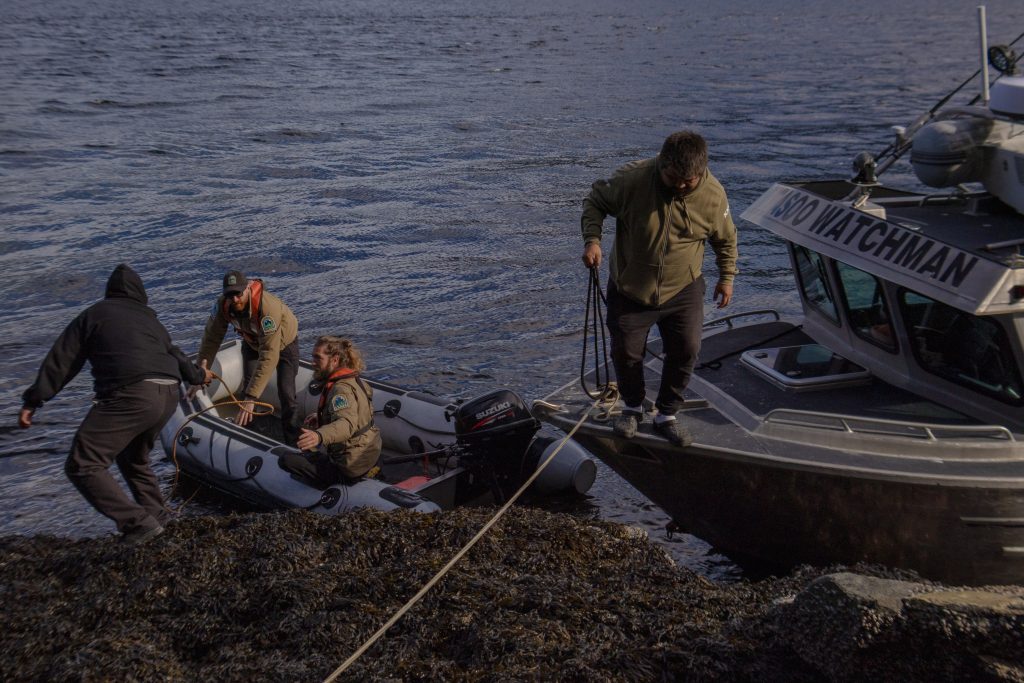
Knowledge without practice is useless, so I took on a Guardian Watchmen position. This allowed me to serve the community using my prior work experience as a Park Ranger and at the same time gain experiential learning about how cultural and spiritual aspects shape stewardship in the territory and demonstrate accountability beyond the research. Shared work with the Stewardship Director, Guardian Watchmen and community members led to deeper understanding through hands on learning and intergenerational knowledge transfer.
Alignment with the
BC first nations climate strategy
This research aligns with the BC First Nations Climate Strategy and Action Plan by centering Indigenous governance, cultural and spiritual stewardship practices, and community-defined priorities as the foundation for climate adaptation and mitigation. Through the co-development of a cultural monitoring tool and supporting multiple Nation-led marine protected areas with the Kitasoo Xai’xais Nation, this work advances the strategy’s call for values-based, place-specific climate action that addresses cumulative impacts while strengthening community capacity and resilience.
Indigenous self-determination
and governance
A key theme that resounded throughout the global literature review conducted on the cultural and spiritual aspects of Marine Protection was that without Indigenous self-determination and governance, federal and provincial marine protection policies tend to fail. Conflict arises when Indigenous People are not included in the decision-making and design of protection within their territories. Ensuring that conservation policies and by virtue, climate adaptation and mitigation initiatives, are co-created with Indigenous Nations from the outset, including the research design and implementation, are critical for successful outcomes ecologically, economically, and socially.
The Kitasoo Xai’xais Nation boasts a 91 per cent employment rate and just over 54 per cent of their territory is protected. The Nation has been able to achieve these significant figures through multiple economic and conservation endeavors grounded in their guiding principles of respect, reciprocity, interconnectedness, responsibility and intergenerational Knowledge. These guiding principles form the foundation for the KXSA management decisions and are exemplified in the draft Community Energy and Emissions Plan.

Ensuring that the natural environment is preserved for biodiversity and cultural practices while at the same time powering the community with clean, affordable, renewable energy are two goals of the Kitasoo Xai’xais Nation. These priorities echo throughout the territory in their marine management objectives and economic endeavors in forestry and fisheries. Supporting local economic development to prioritize measures that have a positive economic outcome for Kitasoo Xai’xais and its people is done by addressing infrastructure vulnerability to climatic extremes through the building retrofits and heat pump installations, expanding renewable energy generation, and strengthening and growing the community-based fishery.
alignment with the action
Plan for disaster risk reduction
The Action Plan for Disaster Risk Reduction (DRR) supports the idea that disasters are not natural, they are the result of exposure and vulnerability, which are shaped by governance, infrastructure, land use, and social conditions. The plan acknowledges that top-down emergency management models are insufficient and must prioritize upstream investments like resilient infrastructure, ecosystem protection, community-level planning, data, monitoring, and locally relevant indicators of risk. These objectives align strongly with Kitasoo Xai’xais approaches to stewardship and climate action and mitigation. The research I am conducting with Kitasoo Xai’xais operationalizes the DRR in an Indigenous governance context by identifying cumulative effects of development as a driver of vulnerability and through re-centering Indigenous culturally and spiritually grounded decision-making and by challenging colonial conservation and climate emergency paradigms. We recognize that resilience comes from healthy relationships with land, sea, and air. These relationships are necessary for cultural continuity, traditional food systems, biodiversity abundance, energy sovereignty and ultimately climate change resilience.
Key transferable
Learnings
Key transferable learnings from this work include firstly, centering Indigenous cultural and spiritual Knowledge systems, rather than solely western science, in decision-making authority. Secondly, addressing cumulative effects of provincially and federally approved projects, rather than isolated hazards and thirdly, designing climate actions that deliver holistic benefits for community well-being, ecological health, and socio-economic prosperity. This research, combined with the Kitasoo Xai’xais Community Energy and Emissions Plan demonstrates how Indigenous-led stewardship and governance guided by cultural and spiritual principles function as proactive disaster risk reduction.
Breaking down silos between sectors and institutions requires accountability beyond research and broader climate objectives to ensure Indigenous laws and Knowledge systems are well understood and upheld both on the ground and in policy. For researchers and practitioners this highlights the need to move beyond extractive models toward reciprocal, co-developed partnerships that honor the Nations stewardship principles to ensure preservation of both nature and culture and tangible benefits to the communities. Enhancing climate adaptation and mitigation across British Columbia will depend on long-term investments in Indigenous-led governance, capacity building, and stewardship practices that have sustained resilient territories for millennia.
Zoe Leech is a Master’s student at the University of Victoria, and a recipient of a PICS Uplifting Reciprocal Research Scholarship.

In honour of the Relationship Protocol between the Pacific Institute for Climate Solutions (PICS) and the First Nations Leadership Council (FNLC), this Knowledge Highlight series reflects PICS’ commitment to supporting the priorities of the BC First Nations Climate Strategy and Action Plan and the Action Plan for Disaster Risk Reduction by First Nations in BC through capacity building, research, and education.