Supporting co-designed research that strengthens
First Nations climate leadership
After a great start, the Circle of Practice is relaunching in Fall 2026 as a participatory, practice-oriented space for those working across Indigenous climate research partnerships and co-design.
Building off the foundation of our earlier sessions, the Circle of Practice will create opportunities to share experiences, explore emerging practices, work through shared challenges, and continue to build relationships across the PICS network.
This space is open to new members. Whether you are new to the field or have an abundance of experience, you are welcome to join.
Sign up and help shape this casual space for shared learning.
Why join?
In spring of 2025, PICS invited a diverse cross-section of researchers to the Bridging Knowledges for Climate Action workshops at our four network universities.
Participants expressed a need for a sustained space for dialogue, co-learning, and collaboration in the space of Indigenous led, collaborative, and co-designed climate research. They were looking for a space to learn from Indigenous scholars, community leaders, and researchers with experience in community-oriented research.
That’s why the Circle of Practice started.
By joining you’ll have a chance to:
- Begin from wherever you are
- Learn from others
- Reflect on your own research practice
- Connect across universities and disciplines
Upcoming Circle of Practice Sessions
This October 2026, a participatory, practice-oriented Circle of Practice begins. In the first sessions participants will be invited to guide upcoming topics.
If you’re new, check out our past sessions and resources sections.
Session registration is via Zoom. Participants are welcome to join anytime. For missed sessions, a summary will be shared with registrants.
Fall sessions:
- Tuesday, October 27: Relaunch: Shaping the next stages of our shared learning
12-1pm - Tuesday, November 24: Co-design in practice: Experience exchange
12-1pm
Winter and spring session topics and dates to be set by participants.
Past Sessions
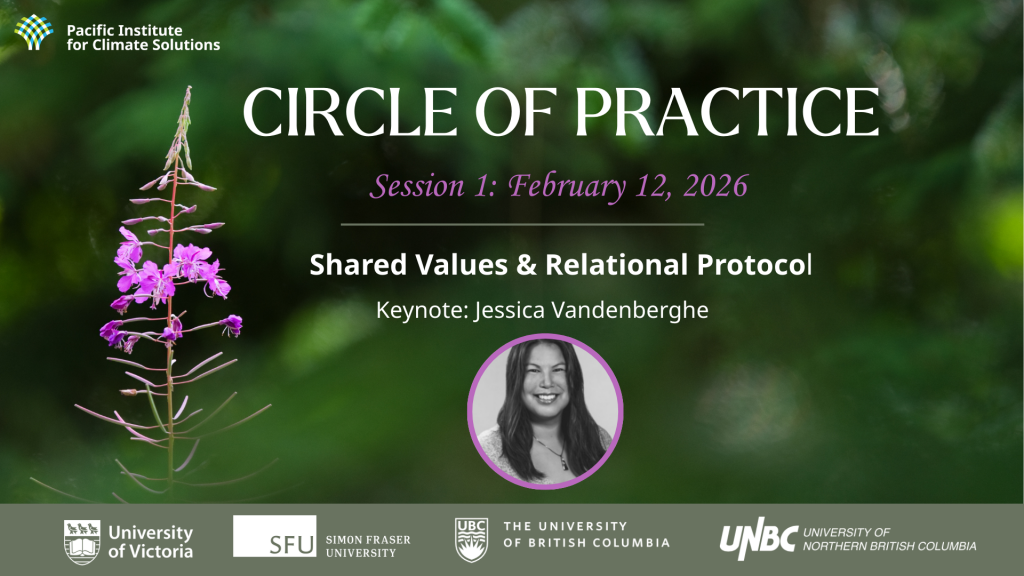
February 12, 2026: Shared Values & Relational Protocol
Special guest Jessica Vandenberghe guided participants through a circle practice, inviting the group to reflect on questions about the values, ideals and protocols that should guide the Circle of Practice. With the focus on dialogue and reflection, this session was not recorded.
March 12, 2026: Scholars Showcase: Uplifting Reciprocal Research Scholarship Program
Three Uplifting Reciprocal Research Scholars share their experiences building and implementing co-designed research. From archaeology to kelp forest restoration and flood mapping, these young researchers are learning in real time how to bridge academia and community knowledge to better serve the rights and interests of First Nations. In this recording they share their insights.
April 9, 2026: Indigenous Climate Leadership & Governance with Dr. Graeme Reed
Dr. Graeme Reed, Strategic Advisor at Assembly of First Nations, provides a powerful presentation exploring how Nations are leading climate action rooted in their own laws, governance, and protocols. The recording gives a crash course on re-framing climate issues from an Indigenous governance perspective.
May 14, 2026: Scholars Showcase 2: Uplifting Reciprocal Research Scholarship Program
Three more recipients from the Uplifting Reciprocal Research Scholars program share how they are navigating the opportunities and barriers that come with being an academic researcher working with Indigenous communities. Spanning conservation finance, northern forest service roads, and combining geomorphology, paleoenvironmental reconstruction, archaeology, and oral histories
June 11, 2026: Shifting Power in Research Collaboration with Dr. Jonathan Moore
Have you wondered how to break down barriers to make research partnerships more equitable?
Dr. Jonathan Moore, Professor, Aquatic Ecology & Conservation at Simon Fraser University shares approaches he’s used to build long term partnerships with communities that centre community needs. Frank and full of approaches that have worked, there is much to learn from this presentation and Q & A.
Resources
Participants at the Bridging Knowledges for Climate Action workshops expressed interest in continued learning opportunities and best practices. Within the PICS university network there are numerous courses and resources available, we have included a selection of these below to guide independent learning.
If there is a resource you would like to see added to this listing, please share your recommendation.
University courses (open to all)
Reconciliation Through Indigenous Education – UBC – free, open course
Enhance your understanding and knowledge of practices that advance reconciliation in the places where you live, learn, and work. This course will help you envision how Indigenous histories, perspectives, worldviews, and approaches to learning can be made part of the work done in classrooms, organizations, communities, and in everyday experiences in ways that are thoughtful and respectful. In this course, reconciliation emphasizes changing institutional structures, practices, and policies, as well as personal and professional ideologies to create environments that are committed to strengthening relationships with Indigenous peoples.
Working with Indigenous Communities: Best Practices – UNBC – paid, open course
The purpose of this two-module course is to provide participants with an overview of Indigenous, non-Indigenous relations in Canada up to the present. The first module reviews the key historical and contemporary events that have contributed to this complex relationship. The second module presents options and ideas that may help your organization develop its own best practices when working with Indigenous communities.
Co-Management of Natural Resources (CNR) Micro-Certificate – UBC – paid, open micro-certificate
The UBC Haida Gwaii Institute’s Micro-Certificate offered by the Faculty of Forestry is a flexible online program that provides Indigenous and non-Indigenous professionals with an opportunity to gain the competencies required to build and implement tools and strategies for advancing co-management initiatives, institutional and relational change, and intercultural understanding.
Indigenous-led courses
The Fundamentals of OCAP® – First Nations Information Governance Centre – paid, open course
The First Nations Information Governance Centre provides resources and training on Indigenous data sovereignty. Newly revised and reimagined to mark the 25th anniversary of The First Nations Principles of OCAP (Ownership, Control, Access and Possession), the Fundamentals of OCAP® course is a unique online learning opportunity developed by FNIGC in collaboration with First Nations thought leaders, subject matter experts, and online education professionals. The course introduces the OCAP® principles in a welcoming and culturally engaging way and takes learners on a journey through the importance of First Nations ownership, control, access, and possession of First Nations data.
Indigenous Corporate Training – paid courses and free resources
Indigenous Corporate Training (ICT) is an Indigenous-owned and operated business that has been providing Indigenous relations training to organizations and individuals for over 20 years. ICT offers introductory and advanced courses, training programs, resources, and partnerships to promote cultural competence, reconciliation, and the empowerment of Indigenous peoples.
Resources for university staff and students
Simon Fraser University
Indigenous Curriculum Resource Centre Collection – SFU, Burnaby campus
The Indigenous Curriculum Resource Centre (ICRC) in the W.A.C. Bennett Library supports faculty members, instructors, and course designers to decolonize or Indigenize their courses, with a collection that focuses on:
- impacts of colonization on Indigenous Peoples in Canada;
- what decolonization means in different subject areas;
- importance of authentically including Indigenous scholarship and voice in course materials.
The ICRC collection is built on the ARC definition of “Indigenization” as uplifting Indigenous knowledges and weaving or braiding them into current pedagogy and curriculum, to be learned alongside Western knowledges. Further develop individual competencies and promote positive partnerships by exploring the RESPECT project.
University of British Columbia
In/relation: Supporting new learners to Indigenous topics at UBC
An educational resource for instructors, staff and students at UBC who are interested in exploring Indigenous histories and contexts at UBC with others who are new to these topics. in/relation contains facilitation tools and support for those choosing to initiate and lead these learning conversations as well as sample learning modules and a framework for organizing the learning. The website also contains the background and research that informed the development of in/relation and houses stories of how the resource has been applied.
The Indigenous Learning Pathways (ILP) program
A self-directed, multi-course suite of training that supports new employees to meaningfully and respectfully engage with Indigenous histories, knowledges, perspectives, and realities in their role at UBC. Through a series of guided activities, reflections, and learning prompts, ILP orients learners to Indigenous focused resources already available to the UBC community, providing tips and ideas for how they can be creatively included and utilized in professional and personal development plans.
University of Northern British Columbia
Office of Indigenous Initiatives
The Office of Indigenous Initiatives supports UNBC’s reconciliation efforts by fostering meaningful relationships and advancing initiatives that honour Indigenous knowledge and traditions. Guided by the principles of the Four Rs—Respect, Reciprocity, Relevance, and Relationships—the office prioritizes creating an inclusive environment where Indigenous and non-Indigenous peoples collaborate and learn. Respect underpins all engagements, ensuring cultural values and practices are honoured. Reciprocity drives efforts to establish mutually-beneficial partnerships with Indigenous communities. Relevance ensures programmes and initiatives address the specific needs and aspirations of Indigenous students, staff, and faculty. Relationships provide the foundation for building trust and fostering long-term collaboration, advancing reconciliation throughout the university. This supports UNBC’s commitment to reconciliation, as indigenization is recognized as one of the pillars of UNBC’s Academic Action Plan.
- Explore the Indigenous Resource Dati (Doorway) for Indigenous-related resources at UNBC.
University of Victoria
The Indigenous Student & Faculty Visioning Consultations: Final Report
Released in spring 2024, centers the voices and vision of UVic’s Indigenous faculty and grad students. The report shares their vision for the future of Indigenous research at UVic.
Office of Indigenous Academic and Community Engagement
The Office of Indigenous Academic and Community Engagement provides services for Indigenous students at UVic and supports connection between the UVic community and Indigenous Elders. They also operate the First Peoples House, a social, cultural and academic centre for Indigenous students at UVic.
UVic Libraries Indigenous Hub
Created by UVic Libraries to provide information pathways to help your learning journey. The information is intended to help advance truth, reconciliation, and the establishment of respectful relationships.
The Pacific Institute for Climate Solutions (PICS) has entered into a Relationship Protocol with the First Nations Leadership Council (FNLC). Through this protocol, PICS is supporting the implementation of the B.C. First Nations Climate Strategy and Action Plan and the Action Plan for Disaster Risk Reduction by First Nations in B.C. These frameworks present a strong vision for First Nations-led climate action and emergency management, supporting current and future generations in achieving self-determination to care for the Earth and ensure health and stability in the face of the ongoing human-made climate crisis.