by Zoë Yunker
On a late afternoon in May, Tom Mommsen steered his Honda Civic towards the BC Ferries ticket kiosk, heart racing, with just enough time to catch the ferry home to Galiano Island.
The back of Mommsen’s Honda Civic was piled with power inverters. Behind him, a transport truck on loan from a local business hauled solar panels. Together, they were carrying 23 tonnes of glass, copper, and steel that now belong to Galiano residents, whose bulk solar purchase marked the beginning of the Salish Sea Renewable Energy Co-op.
“We wanted to take action,” said Risa Smith, who helped found the co-op with Mommsen and other community members.
“I think so many people want to take positive action, especially now.”
Just over ten years later, theirs is among a small but growing movement of collectively owned climate action initiatives in the province.
By carving out spaces beyond conventional market capitalism, models of collective ownership can make things happen that otherwise wouldn’t. Though their structures vary, collective ownership allows communities to pool their efforts, labour, and funds to realize solutions that would be unavailable to individuals acting alone and uninteresting to private-sector companies focused on maximizing returns.
One pathway for collective ownership in B.C. is the Province’s recent requirement that all new utility-scale[1] renewable energy contracts include First Nations’ equity ownership. Yet there is little to no policy support for smaller First Nations-owned renewables, nor for collective ownership in other communities.
Instead, Canada and B.C. have focused on a big-box model of economic growth, while cutting or diluting many of their climate policies. As major new emissions sources like liquified natural gas (LNG) come online, governments’ ability to meet their climate targets increasingly relies on individuals choosing to shoulder the costs of building retrofits and buying EVs — actions that become more challenging as the affordability crisis intensifies.
It’s no surprise that climate has fallen off the top list of voting concerns, said Dr. Holly Caggiano, assistant professor of climate justice and environmental planning at the University of British Columbia (UBC).
“It’s a complicated, difficult moment for many reasons,” she said. “What are people trying to do? They’re trying to meet their basic needs.”
Caggiano sees collective ownership as a multi-tool for wicked problems: when faced with economic hardship and the climate crisis, she sees opportunities to address both.
“We can think about this across types of needs we have, whether it’s energy or food or housing. How can we think about different ways to do things?”
– Holly Caggiano, University of British Columbia
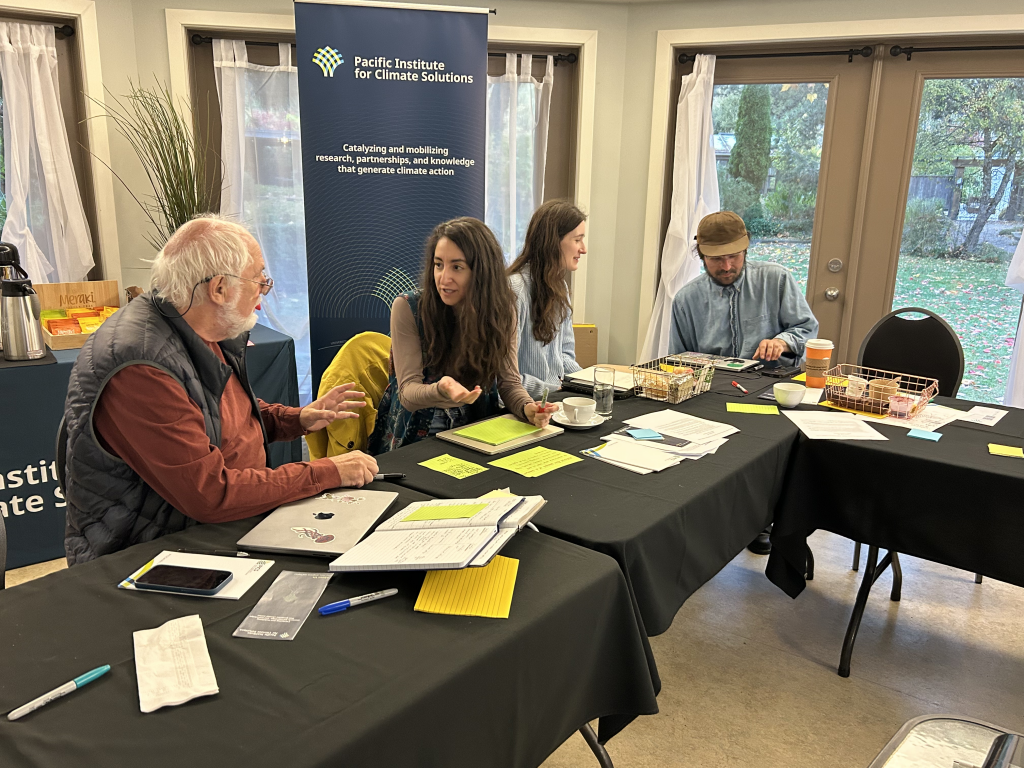
Last fall, Caggiano co-convened a group of researchers and community practitioners on Galiano Island for a Climate Foresight Dialogue hosted by the Pacific Institute for Climate Solutions, along with co-organizers Alex Tavasoli (UBC Mechanical Engineering) and Ana Guerra Marin (Iron and Earth).
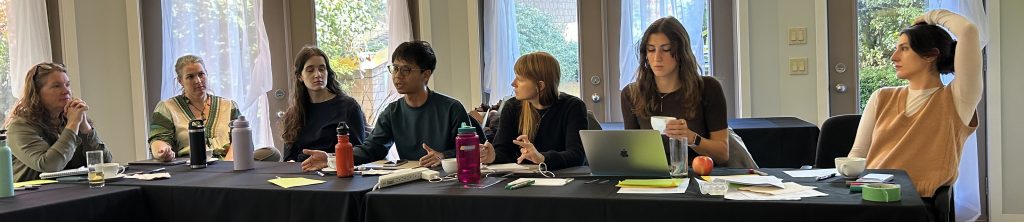
During the three-day workshop, they investigated ways collective ownership can propel climate action while simultaneously addressing the immediate needs of B.C. communities. The Dialogue generated connections and directions for longer-term collaboration among researchers and practitioners to advance collective ownership models for climate-positive infrastructure in B.C.
What is collective ownership, anyway?
As a practice, the roots of collective ownership extend across millennia: communal stewardship of resources has shaped the governance traditions of many Indigenous Nations worldwide.
From the early days of industrial capitalism, producers, buyers, and workers have built co-operatives to enable collective governance and advocate for better prices or conditions in a market economy. These histories range from tweed and muslin weavers in 18th century Scotland, who banded together to set a price floor for their wares, to Black sharecroppers in 20th century Georgia, who launched the first known community land trust in 1969 in the wake of evictions from White plantation owners.
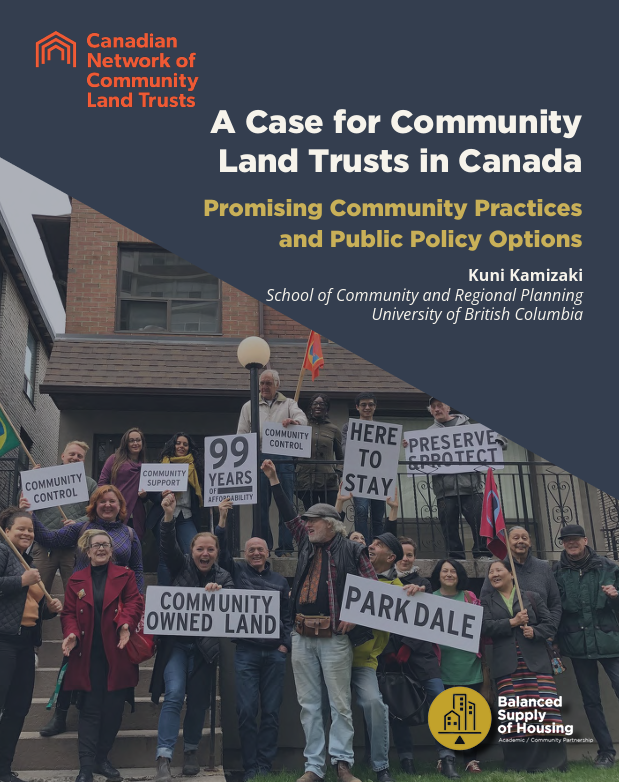
Today, co-operatives and community land trusts continue to serve as organizing structures for collective ownership in Canada and around the world.
And yet that structured approach isn’t the only way communities co-own projects. Collective ownership could include non-profits composed of community members or community networks at various scales. Despite their differences, Giulia Belotti, a UBC PhD student working with Dr. Caggiano to study how collective ownership can support community-led climate solutions, highlights the models’ connective tissue.
“These are projects that should be grounded in direct community decision-making power, accessible to a defined set of community members, responsive to community needs and working at a relatively local scale,” she said.
Attuned to members’ needs, collectively owned projects tend to focus on things the market misses, like affordable, energy-efficient housing, locally produced energy, and secure access to food and ecosystems that are resilient to floods and other disasters. It just so happens that these tools are also vital in community responses to climate change, said Caggiano.
“I would think about this as the infrastructure necessary for climate transitions.”
– Dr. Holly Caggiano
By retaining ownership over local projects, collective ownership models can boost local economies in ways that privately owned projects might not.
Worker co-ops, for example, distribute profits amongst employees, keeping wealth in the community rather than sending it to distant shareholders. When it launched its rooftop solar project, Galiano’s Salish Sea Renewable Energy Cooperative hired Viridian Workers’ Co-op to install the panels. The economic benefit was then multiplied, as the solar panels helped members save on their energy bills.
Meanwhile, community land trusts frequently choose to invest their equity into energy-efficient retrofits, saving on energy bills while keeping money out of the hands of speculative developers.
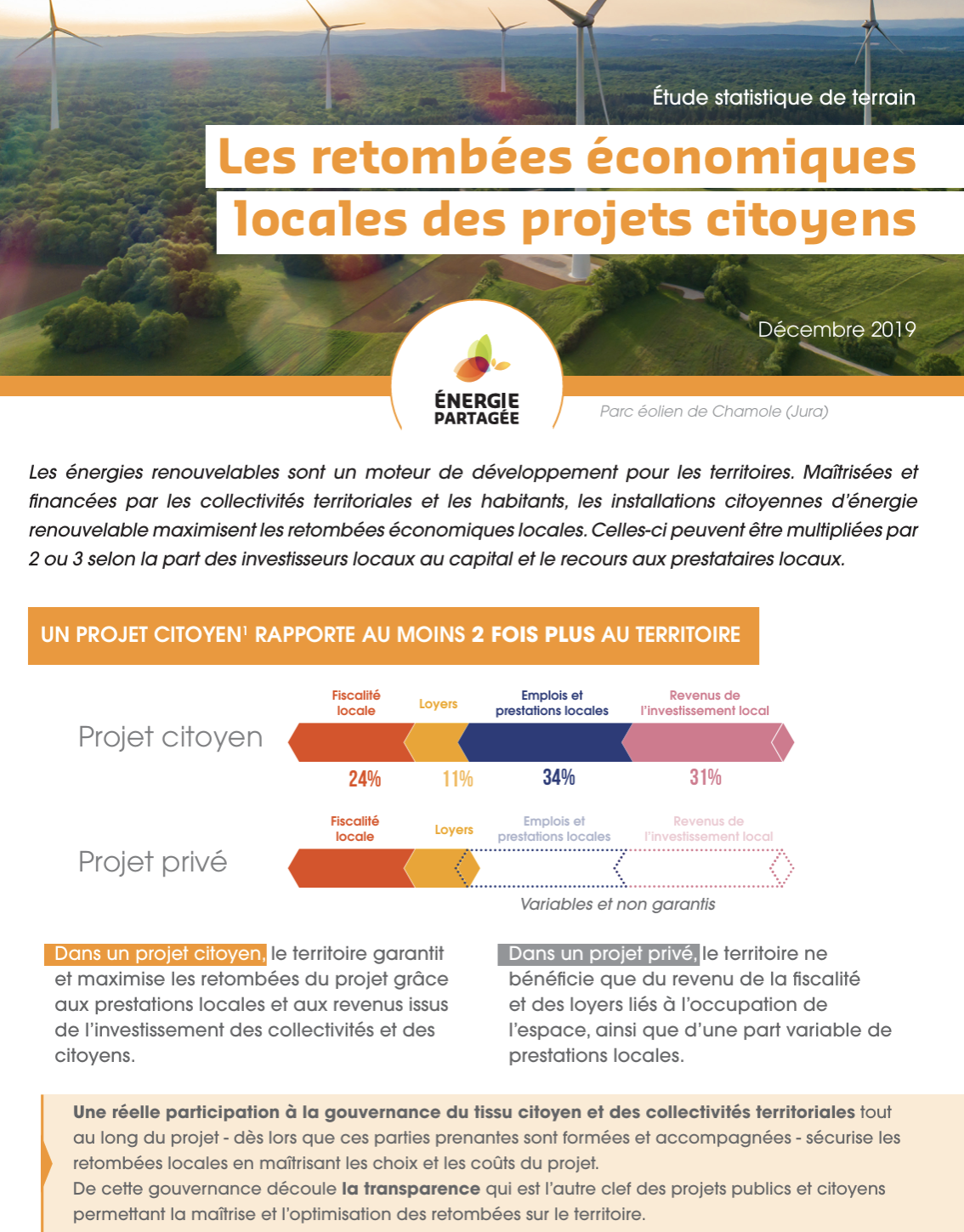
Research on Europe’s comparatively abundant community energy sector has begun to illustrate the compound effects of these choices, finding that community-owned projects generate between two to eight times more revenue for local economies than private developers.
Across various endeavours, collective ownership works best when its community is clear about the problems they’re working to solve, said Bradley Nickel, business opportunity specialist with the co-operative Equs Rea Ltd., which also advises other cooperatives. “The question is, what’s the need?” he said, “and then, what is the story that brings people together?”
For some communities, that might mean the power to weigh risks and benefits of the projects they choose.
“Usually any project, even one aimed at doing good, has trade-offs,” said Belotti. “If you have someone coming in, whether it’s the government or a private company, communities basically lose that ability to decide what their trade-offs are.”
Despite its green credentials, climate infrastructure is not immune to the dispossession and exploitation common in resource sectors. Privately owned, utility-scale renewable energy projects, often owned by finance giants like pension funds, tend to pay lower wages than the fossil fuel sector, hire non-union workers, and provide scarce benefits to the communities whose regions face their greatest effects.
Unsurprisingly, resistance to renewable energy development is emerging as a consistent barrier to its expansion. But collective ownership models offer a salve for this, too: research shows that community resistance to renewable energy development fades when communities can access an equitable share of project benefits and a meaningful role in the decision-making process — benefits that collectively-owned projects naturally bestow.
“There’s a lot more support for windmills when people can actually benefit from them,” said Ilonka Marselis, vice president of REScoop, the federation for community energy in Europe.
Cognizant of these myriad social and economic benefits, the European Union has recently taken a bold stand on community energy initiatives. Wary of the political risks of Russian gas and aware of the need to build local economies and lots of renewable energy quickly, the EU now requires its member states to enact laws to support community ownership of renewable energy and energy storage technologies, and to set targets for its expansion.
The European Union now requires its member states to enact laws to support community ownership of renewable energy and energy storage technologies, and to set targets for its expansion.
The EU’s recent moves signal a new direction, said Julie MacArthur, a Professor and Canada Research Chair in Reimagining Capitalism at Royal Roads University, towards viewing communities not as passive energy consumers, but as critical service providers to the grid.
“This is a big shift,” she said. “And that’s not what we see here.”
Stumbling blocks
Collective ownership models face an uphill battle in Canada.
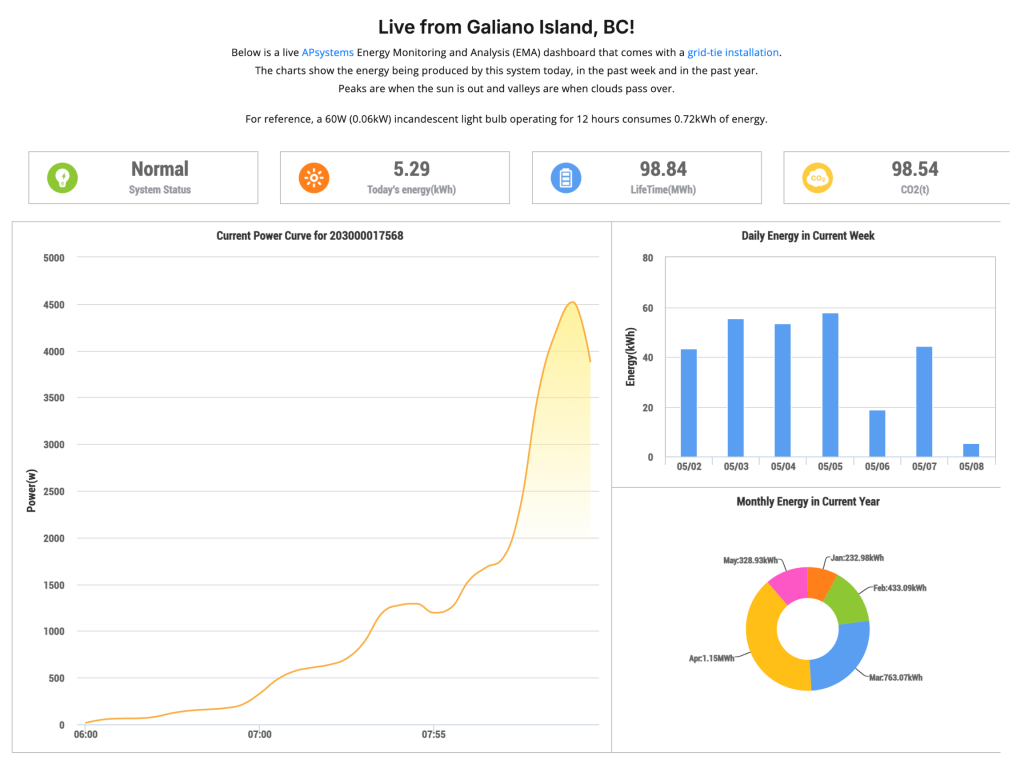
Snarled bureaucracy and regulatory barriers are key obstacles for the evolution of Galiano’s Salish Sea Renewable Energy Co-op (SSREC), said co-founder Tom Mommsen.
A case in point: SSREC members and others in B.C. benefitted from a now-cancelled program from BC Hydro, the province’s public utility, which allowed solar producers to use the main grid like a battery: they delivered power to the grid during sunny hours, and could draw an equivalent amount of electricity from the grid, free of charge, when the sun wasn’t shining.
Now, without that battery service, rooftop solar producers will receive a fixed rate for their solar power when the sun shines, and buy BC Hydro’s power the rest of the time. That fixed rate is lower than BC Hydro’s retail price, and as BC Hydro rates rise over time, that gulf could further widen, meaning the business case for rooftop solar could deteriorate.
The likely upshot of the cancellation, according to Mommsen, is that the already limited cost-benefit case for installing rooftop solar could implode.
“They are killing solar as we speak in B.C.,” he said.
A recent change to B.C.’s solar program means rooftop solar producers can no longer use the wider electrical grid like a battery for their previously generated power.
In a statement, BC Hydro said the previous program “overvalued” the energy it got, adding that the new approach is “fairer to all customers.”
The change coincided with another blow to the Salish Sea Renewable Energy Cooperative’s long-term dream of forging a community-owned solar farm — a chance for renters and shade-dwellers to participate in the benefits of renewable energy ownership. Tom Mommsen is concerned that BCHydro’s new rules establishing a “community generation rate,” counterintuitively, appear to exclude co-operatives from owning shared renewable projects.
Meanwhile, for collective ownership models of all stripes, communities often face a labyrinth of permitting, licensing and accounting hurdles that require copious time and bureaucratic proficiency to navigate. “That’s not sustainable,” said Ana Guerra Marin, communities director and just transition lead with Iron and Earth and a co-organizer of the PICS Dialogue, adding that this limits participation from low-income communities and community members who would likely be hard-pressed to devote the volunteer hours required. A recent census, for example, found that a third of all community land trusts operate without paid staff members.

Indeed, financing presents a third, and similarly daunting, barrier for many prospective collective ownership projects. Banks and other financial institutions are often hesitant to invest in these structures. “When you’re trying to build something, you need money,” said Caggiano; “you need somebody to finance it.”
Efforts to address these gaps in European countries have borne fruit, said Marselis. The European Union provides risk-free funding for new energy communities, meaning communities won’t go into debt if their projects don’t proceed. They’ve supplied the community energy market with subsidies to even the playing field with private developers. “That’s why we saw the huge growth of energy communities,” Marselis said.
‘They trust us’
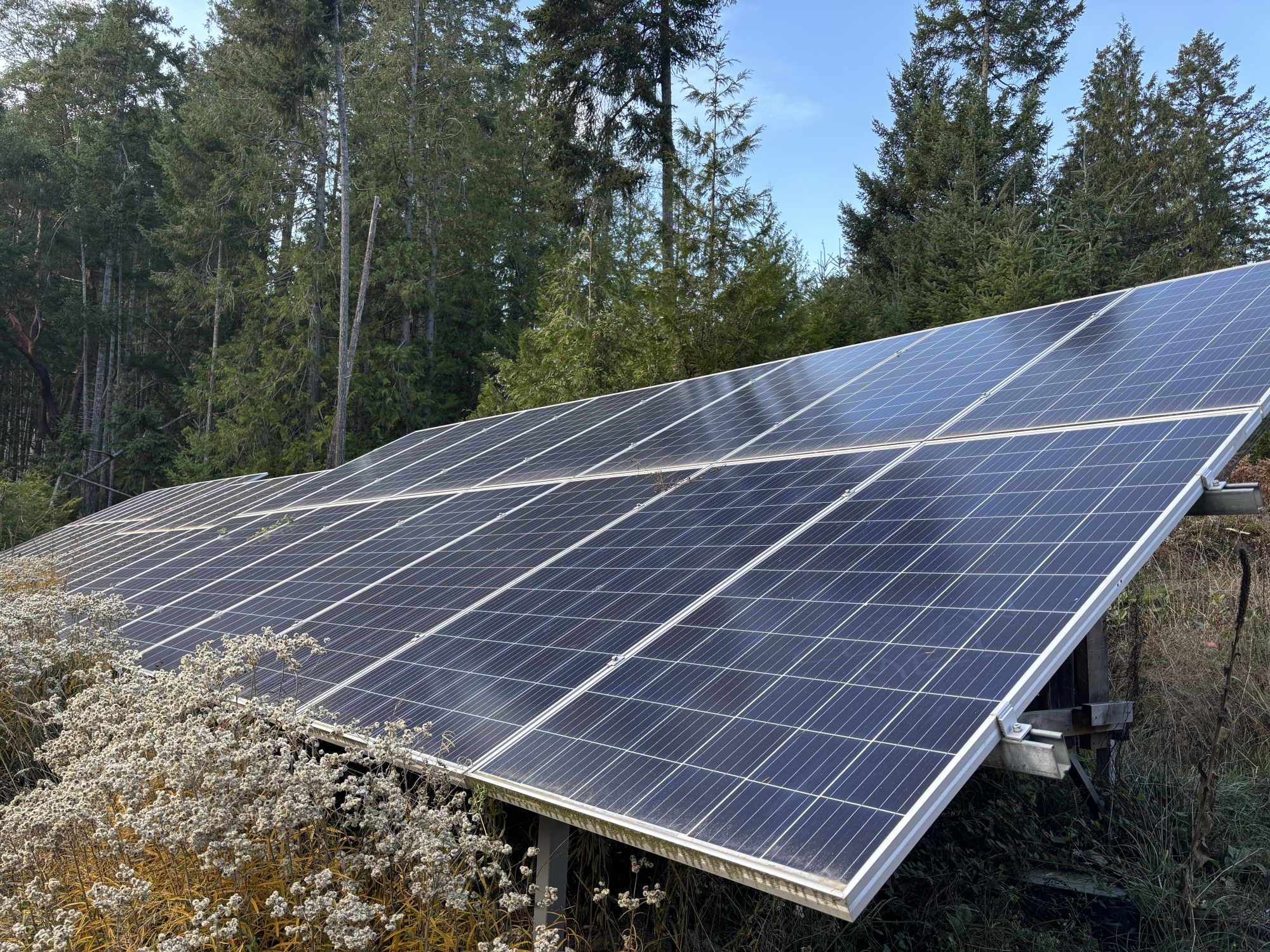
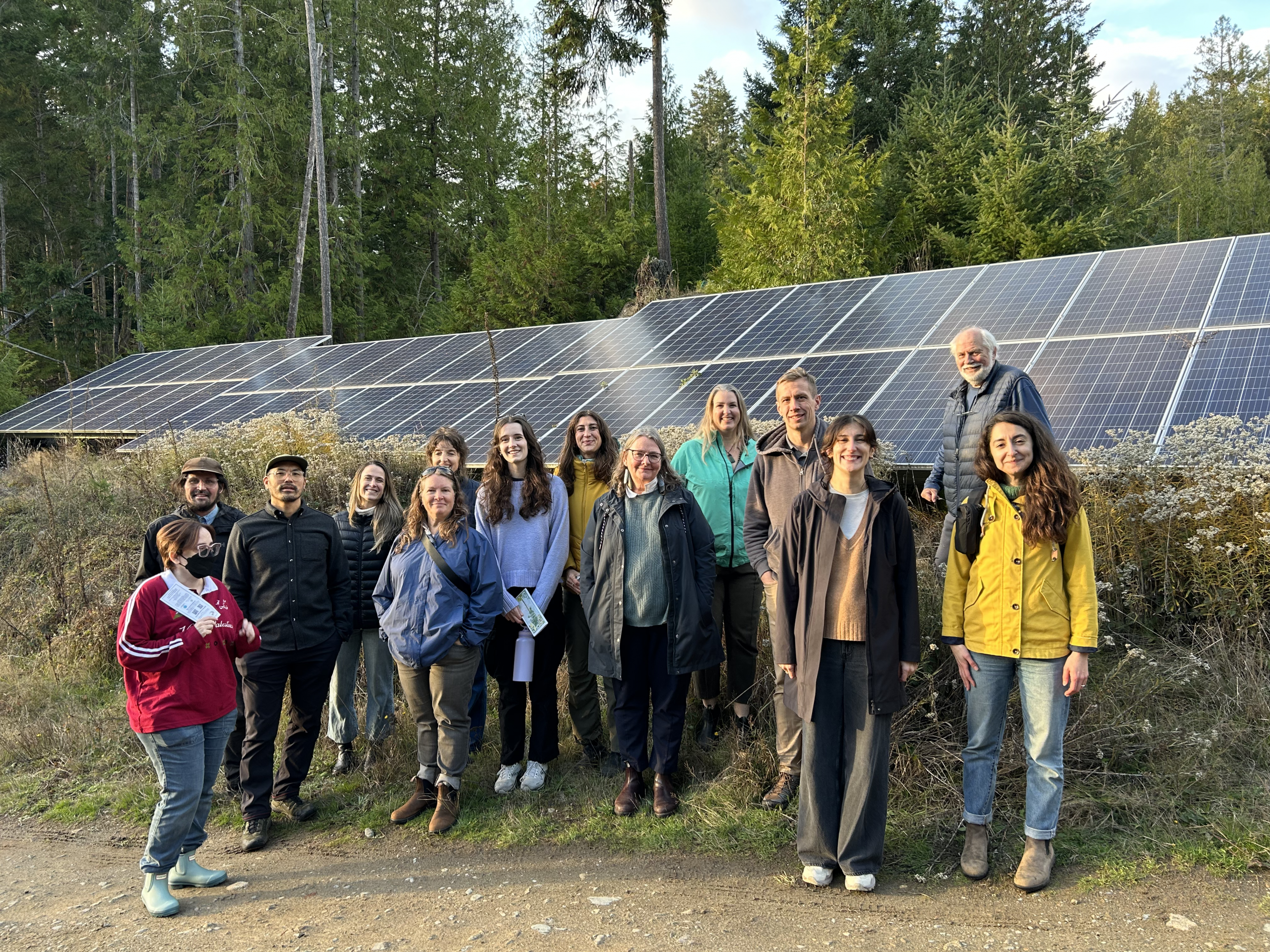
Late afternoon sun pours onto a row of solar panels lined with wildflowers at the headquarters of the island’s land trust, the Galiano Conservancy. Three minutes up the road, Galiano’s electric bus, another community initiative, drives past the volunteer fire hall topped with a solar power checkerboard.
“We’ve been successful,” said Smith, of the Salish Sea Renewable Energy Cooperative’s years-long effort.
“We’ve put up a lot of solar all over the Gulf Islands.”
Their co-operative has evolved over time. As the cost of solar panels declined, it has pivoted from organizing bulk purchases of panels and group installation to advocacy and education, teaching other communities about the benefits of renewable energy.
“We do the background research, and it helps people go over the threshold,” said Smith.
“And they trust us.”
For Mommsen and Smith, the more ephemeral benefits of collective ownership are similarly important. When Galiano Islanders of different political stripes run into each other, they have newfound common ground. “They talk about solar,” said Mommsen, who has seen old divisions mend and new connections begin.
For Guerra Marin, community ownership offers an undersung service that may prove invaluable in the years to come.
“People feel disconnected, and they want to build community,” she said.
“These kinds of projects can be a space for them to do that.”
Read the full Dialogue report ↓
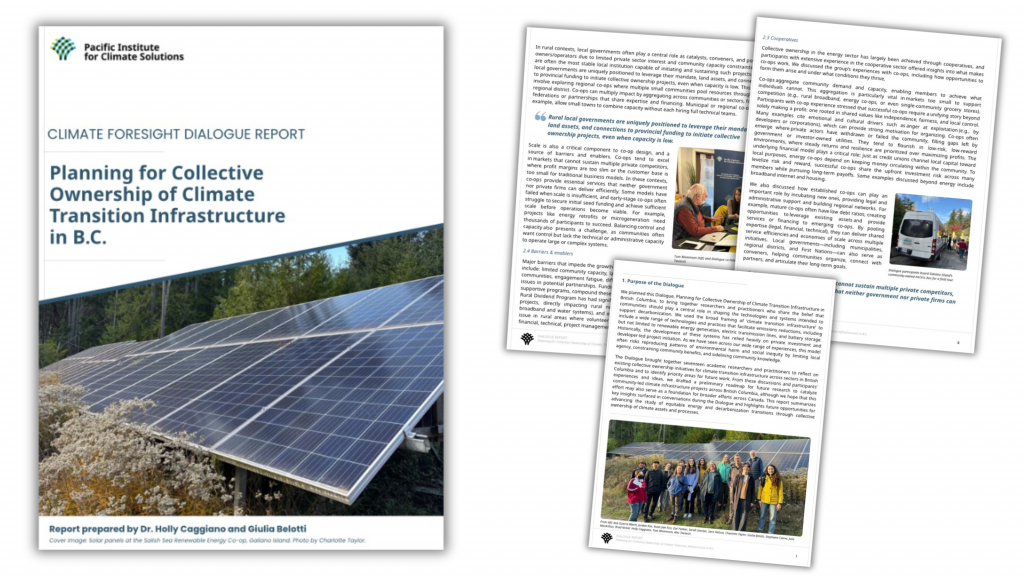
The Dialogue on Collective Ownership for Climate Transition Infrastructure was organized by Dr. Holly Caggiano (UBC School of Community and Regional Planning), Dr. Alex Tavasoli (UBC Mechanical Engineering), and Ana Guerra Marin (Iron and Earth).
A detailed report from the Dialogue, including a full list of organizers and participants, is available here.
Zoë Yunker is a freelance journalist writing about forests, energy, climate and environmental politics from Songhees, Esquimalt and W̱SÁNEĆ Territories.
[1] Large-scale, high-capacity power projects that feed electricity directly into the grid rather than powering a specific home or business.