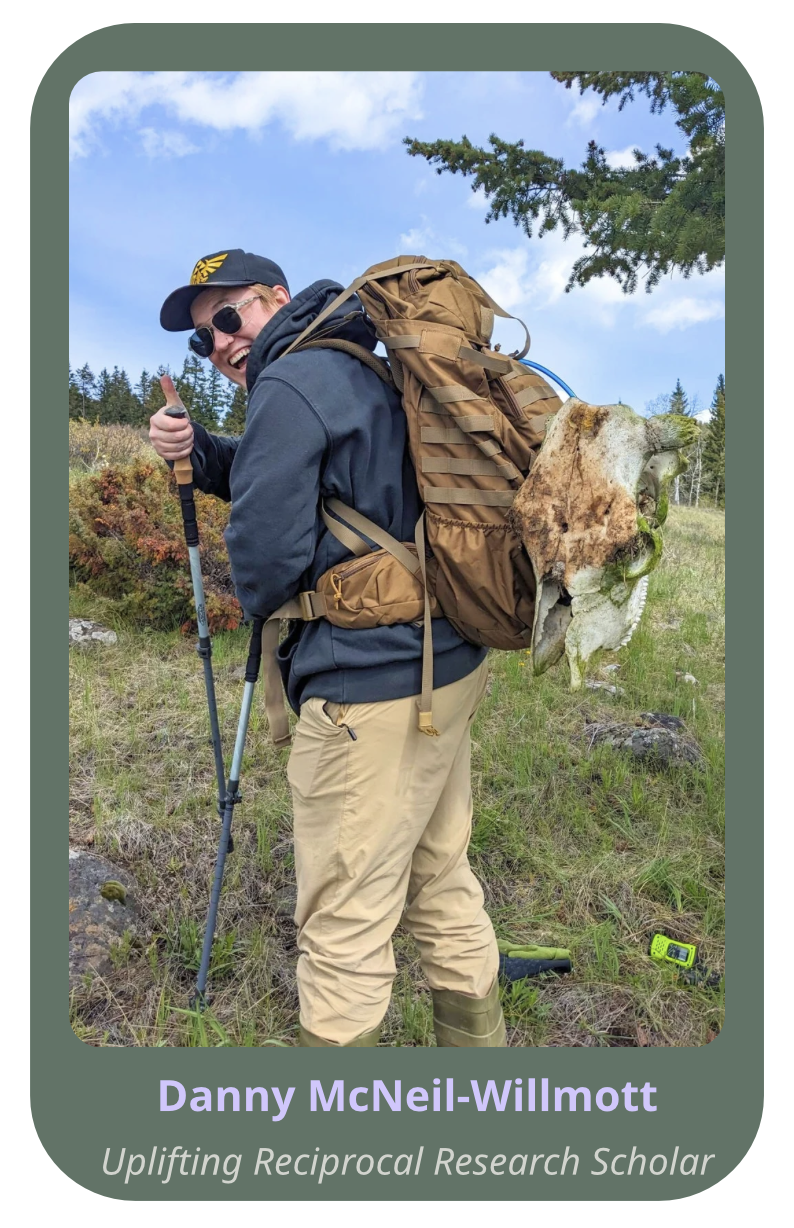
Taanishi, Danny dishinihkaashoon. Ma faamii daan la Rivyayr Roozh ooshchiiwuk. Mii noon di faamii si Nault, Perreault, Carriere, Ducharme, pi Beauchemin. Ma paraantii a St. Boniface, St. Norbert, St. Vital, pi Wasushk Watapa (Rat River).
(Hello, my name is Danny. My Family is from the Red River. My family names are Nault, Perreault, Carriere, Ducharme, and Beauchemin. My ancestors are from St. Boniface, St. Vital, and Wasushk Watapa (Rat River)).
Like many Indigenous people across Turtle Island, my family’s connection to their ancestral language, Michif, was intentionally severed. Centering my opening introduction in Michif is a small act of resistance I am working hard to cultivate in my day to day. An intentional act of tending to something that was deliberately harmed.
I am PhD student at the University of Northern British Columbia, and have been fortunate enough to be a recipient of the Uplifting Reciprocal Research Scholarship provided by the Pacific Institute for Climate Solutions (PICS).
Before I dive into the meat and potatoes of this Knowledge Highlight, I want to take a moment to speak about who I am and how I have come to be here. I think personal context is important when trying to understand the why of someone’s research.
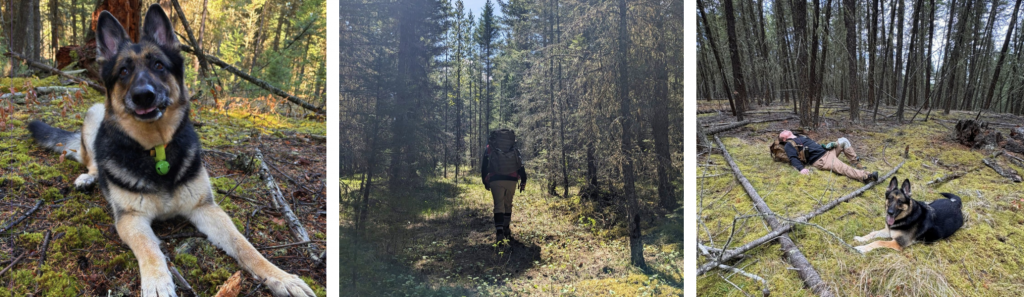
I was born on, and spent the first thirteen years of my life, in various parts of Kanienʼkehá꞉ka (Mohawk), Anishinabewakiwk, Omàmìwininìwag (Algonquin), and Mississauga territory. The next thirteen years were spent closer to my maternal grandparents in Métis territory. There is a joke in my family that I was raised by the Great Lakes and the Deshkaan-ziibi (Thames) river. I’m blessed to say water played such an integral role in my childhood.
I’ve always had an affinity for the non-humans in my life, the quiet, weird kid who instantly makes friends with people’s pets. When I was four, I had a meltdown on the way to preschool as I watched a city tree being cut down.
It’s funny, in hindsight, that a dream about a tree is what would ultimately start me down the path to my PhD, but more on that in a moment.
This love of Land and all her inhabitants, combined with an insatiable curiosity about how things work, is ultimately what propelled me into my undergraduate degree in biology and psychology.
As I progressed through my degree, a sense of disconnect followed me. Western science’s fixation on studying things in silos felt entirely out of alignment with how I thought about the world. I wanted to understand the whole picture, how living beings connect and influence one another in the web of life.
As my graduation date loomed closer, I found myself in a bit of a panic. I had no idea what I was doing, and I certainly wasn’t ready to be an “adult.” During this time, I experienced a dream that has, to this day, left an indelible mark on my life.
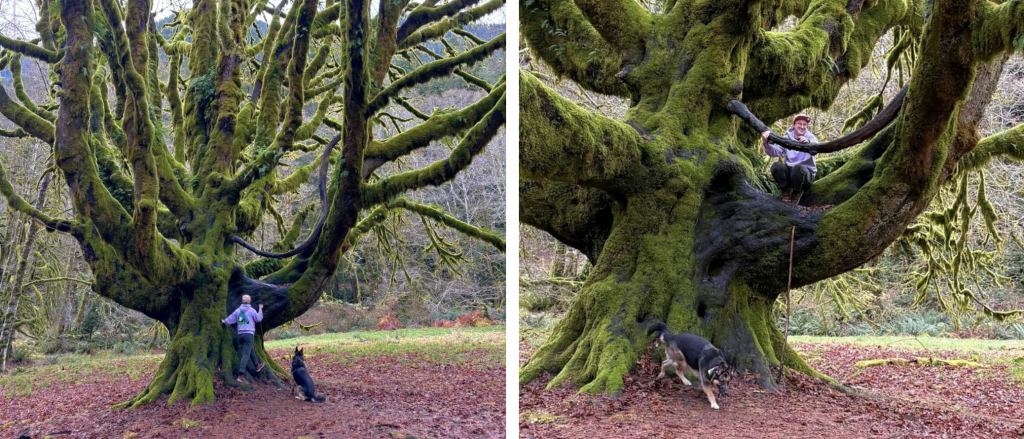
I found myself walking alone along a path through a forest. Out of nowhere, I heard a woman’s voice call my name. I stopped dead in my tracks and turned toward the sound. Instead of seeing a human, there stood an ancient tree. I cannot adequately express the size and presence it emanated. It was magnetic, and I felt compelled to walk closer. As I came to stand in front of this immense being, I heard the woman’s voice again. This time she said, “Danny, you need to return to the Land.” I stared at the tree, puzzled.
Again, I heard her voice repeating that I needed to return to the Land, but this time she was more urgent and forceful. I felt compelled by the tree once more, only now I was overwhelmed by the urge to lay my hand against it. I heard her repeat herself for a third time just as my hand came to rest on the thick bark. As soon as my palm made contact, I felt a pulse of energy surge up my arm and disperse through my whole body. The sensation was so pronounced that it woke me from the dream, sending me bolt upright in my bed.
I wish I could say that I immediately heeded the message from my dream, but foolishly, I set it aside. It would take completing my master’s in Gender, Sexuality and Women’s Studies, followed by a full-blown mental health crisis, before I began taking the steps needed to do as that voice had counselled me to.
After a less-than-linear trajectory, I eventually found myself working for a First Nations-owned environmental consulting company. When I was first invited onto the team, I was ecstatic. I thought I had finally found a workplace environment that shared the values I hold dear. As time went on, it became very clear that the primary focus of the work was to ensure natural resource companies complied with their environmental obligations as dictated by colonial environmental policy. The experience was soul-crushing.
I realized I was yearning to be a part of a project rooted in Indigenous values and worldview. Consulting wasn’t fulfilling those needs, so I started daydreaming about what this could look like outside of the consulting world.
Through a series of serendipitous events, I found my way to a project that is fully grounded in understanding how Indigenous forest stewardship is healing the land, and the relations that rely on it.
WHAT I AM UP TO
This research is being conducted in partnership with T’exelc’s (Williams Lake First Nation) Forestry Team. There is a strong interest in evaluating how T’exelc’s context-specific, fine-scale forest stewardship model is restoring wildlife habitat within fire-suppressed forests.
Guided by the Secwepémc principle of “Walking on Two Legs,” my research will use a combined lens of Indigenous place-based science and Western community ecology to provide a holistic examination of ecological community responses to T’exelc-led restoration thinning.
The removal of First Nations fire stewardship from T’exelc territory, through colonizer-enforced fire bans and the loss of Knowledge Keepers to smallpox epidemics, has altered the fire regime from the historic norm of low-to mixed-severity forest fires associated with First Nations Land stewardship. The wide-scale impacts of fire suppression through cultural bans can’t be underscored enough. Once open forests have become ingrown, dense, and increasingly vulnerable to disturbance.
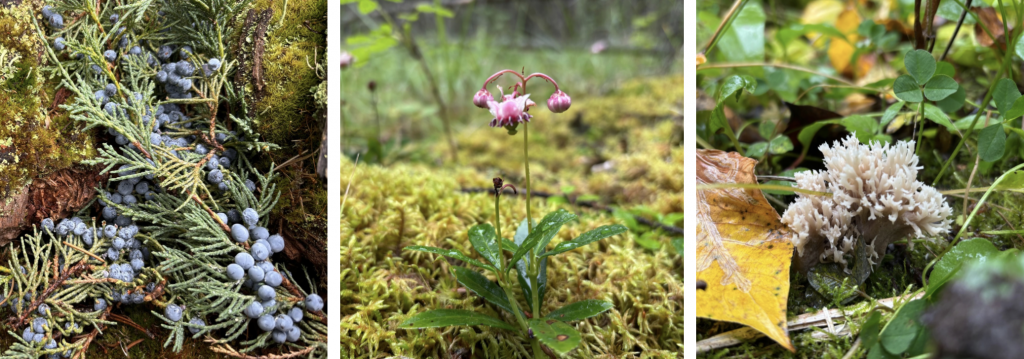
Species with whom the T’exelcemc people have stewarded reciprocal relationships of respect and care with, and who have in turn sustained the people since time immemorial, are disappearing from the Landscape. The loss of ecological resilience within the Landscape web has primed the forests for extreme fire, placing both human and non-human communities at risk.
A barrier-free return to fire stewardship is a critical step in reclaiming reciprocal care with the Land. The T’exelc community’s forest stewardship model seeks to reintegrate fire stewardship, but current forest conditions limit its safe application.
This project serves as an initial step toward the reintroduction of fire stewardship at the scale envisioned by the community. The data collected will help inform the continued development of T’exelc’s Forestry fire stewardship model.
How this work connects
to the BC First Nations Climate Strategy
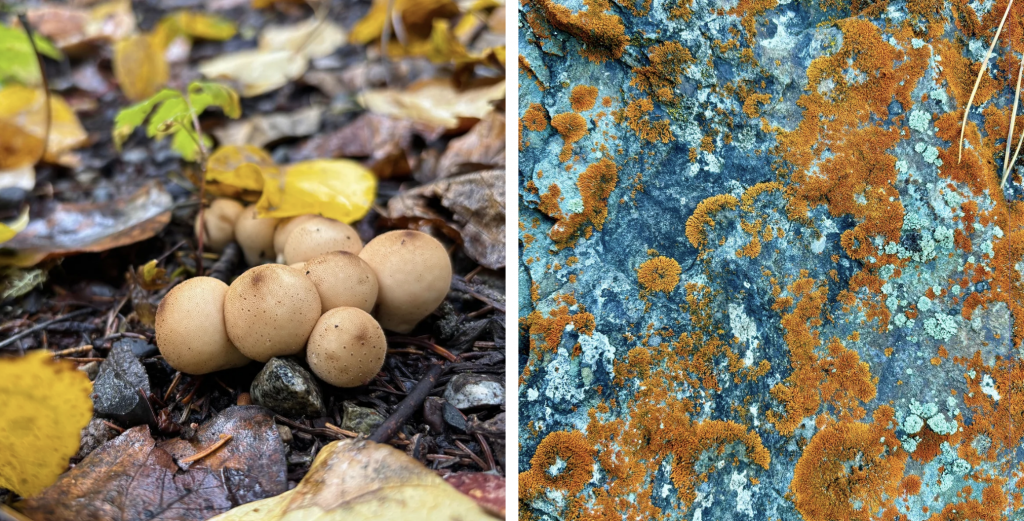
1.5.2. Increase public understanding of the role of colonization and colonial laws, such as the Indian Act, in limiting and restricting First Nations ability to respond to climate change.
This project is a direct response to the consequences of colonial land management policy. The British Columbia Bush Fire Act of 1874 was the first step in a broad institutionalization of the colonial belief that fire is a destructive force, and something timber supplies needed to be protected from. This worldview was in complete opposition to First Nations use of fire as a stewardship tool. The negative impacts of forced removal of fire stewardship were further compounded by short-sighted colonial forestry management and the accompanying worldview that placed an outsized emphasis on timber as a commercial commodity rather than a critically important member of the larger ecological web. This project unapologetically centers these facts and is dedicated to taking steps to ensure the T’exelc community can safely practice widespread fire stewardship once again, while also developing a forestry stewardship model grounded in the needs and vision of the T’exelc community.
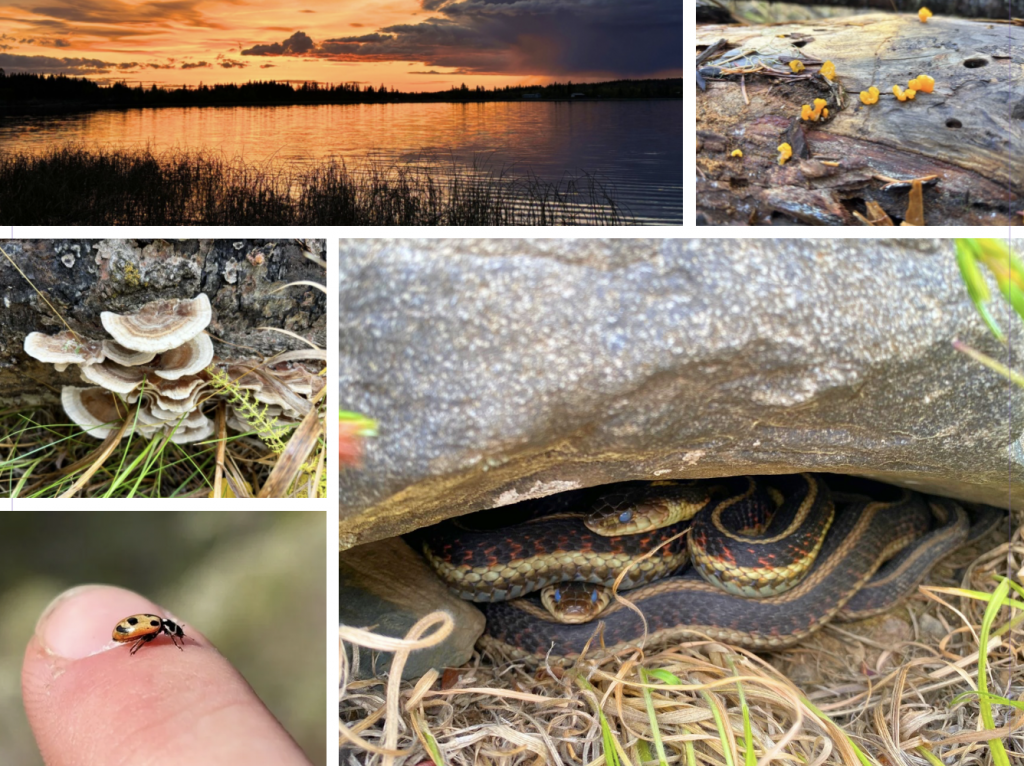
2.4.1. Strengthen First Nations data governance and support Nations in generating, managing, and accessing climate data and information to inform decision-making and climate response
Through the application of the First Nations principles of ownership, control, access, and possession (OCAP) this research aims to create a robust environmental data set that belongs solely to the T’exelc community. This data repository will be accessible to anyone within the community. Additionally, the data collected can be used to inform future T’exelc community objectives related to climate, restoration, and conservation. In keeping with OCAP, the T’exelc community will have final say on how, when, and where findings are communicated, thereby ensuring data sovereignty is maintained. Further to this point, it is my hope that a working group can be developed that allows for co-analysis of collected data as an ongoing process throughout the lifetime of this project and beyond.
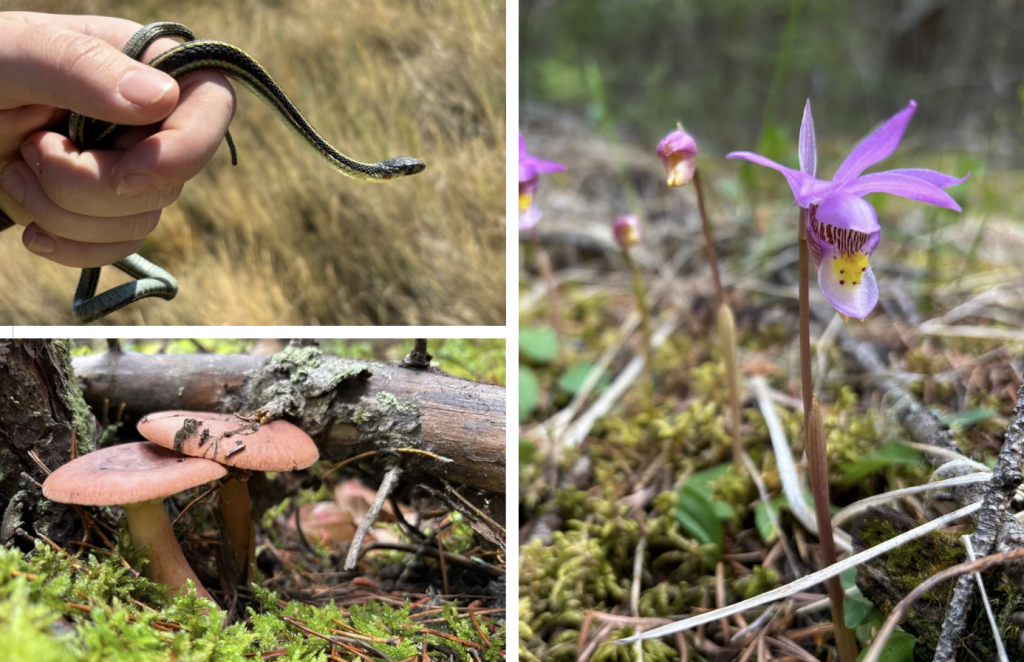
3.1.1. Restore the lands and waters, including natural habitats and native plants and medicines, disturbed due to climate change and/or urban and industrial development (including resource extraction such as logging, mining, and fracking).
This objective of the BC First Nations Climate Strategy is the beating heart of this project. Every aspect of this work is grounded in the awareness of a need for restoring balance and reciprocal care with the Land. Indigenous communities have maintained for time immemorial that humans must have a relationship to Land that is rooted in respect. A foundational part of this respect is participating in reciprocal care through the active stewardship of the Land and all of her inhabitants. Indigenous stewardship has been forcibly replaced by a colonial management paradigm rooted in commercial extraction. This has had profound consequences that are in need of reconciliation. This research looks to take the first step in reconciliation with the Land, by facilitating a restoration process that allows for the recovery of natural habitats that the ecological web within T’exelc territory is predicated on.
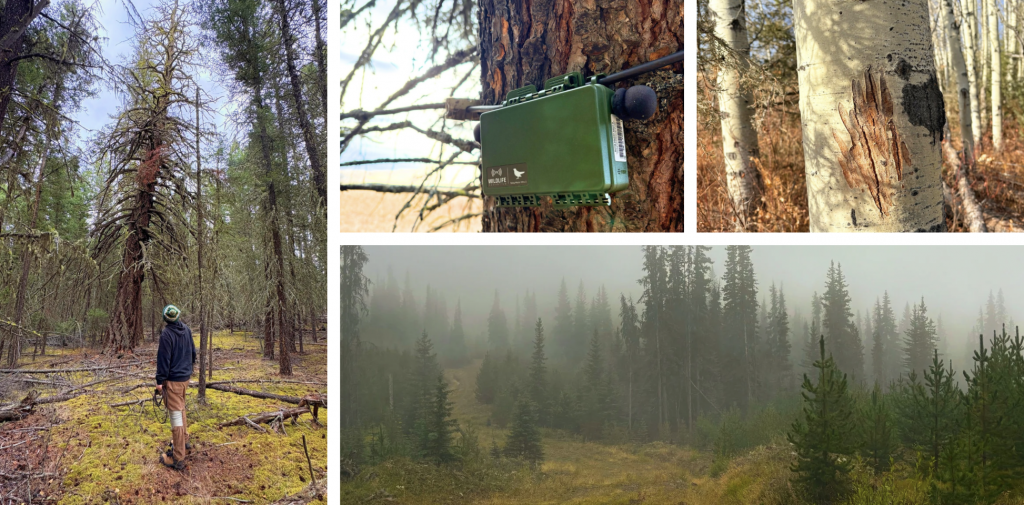
3.3.1. Facilitate forest regrowth and prioritize sustainable forestry management to reduce fires, landslides, and flood risks.
The consequences of sustained forestry practices grounded in the worldview of colonial land management have begun coming home to roost. There is a growing awareness and acknowledgement of the critical role First Nations Land stewardship has played since time immemorial in shaping not just resilient forests, but resilient ecological communities. Natural resource industries must move towards a more respect-based model of resource extraction. We cannot continue to take without equally giving back. Indigenous People have always known this. We must take steps to remedy the current situation we find ourselves in. This project seeks to do that by restoring the forests within T’exelc territory to a condition that allows for the reapplication of wide-scale fire stewardship as an ecological tool for ensuring sustainable forestry management into the future.
First Nations have always approached stewardship through a scientific method of deep observation, trial and error, and adjusting stewardship practices in response to what the Land is communicating. This fact often goes over the heads of non-Indigenous people, but if we are to invest in a sustainable forestry practice that helps heal and mitigate the consequences (fire, floods, and landslides) of the blatant disrespect afforded to the Land under a colonial worldview, then we must all learn to listen to the Land, and adjust our practices as needed from there. This project seeks to provide a model for how that could look and, in so doing, promote a more sustainable forestry management style rooted in an Indigenous worldview.
Practical recommendations
for enhancing research and partnerships
I am a work in progress. My first draft of this Knowledge Highlight went into detail about the complete fumble (but ultimately gift) that was my first formal conversation with community Elders about the research obligations that have been entrusted to me. For the sake of time and space, I felt it needed to be saved for another time. If you ever run into me in public, I encourage you to ask me about it. You’ll very quickly realize I am moving through life flying by the seat of my pants. With that said, I am going to give another caveat before jumping into the recommendations.
The recommendations herein are a product of my own experiences, values, and worldview; all of which are subject to change as I learn and grow.
RECOMMENDATION 1: You must know where and to whom you belong.
It positions you within a broader context that is important for understanding what you are bringing to the table. The foundational tenet of objectivity in Western science is a fallacy. We are not beings devoid of emotionality, experience, and relationships. All of which coalesce to form the very specific lived reality we move through. Radical transparency, with ourselves and those we wish to partner with, is critical for building a relationship that is predicated on more than just the labor or knowledge we can extract from one another.
RECOMMENDATION 2: Do your homework.
It is unfair for outsiders and guests to continually put the burden of initial project development onto Indigenous communities. Research fatigue is a very real experience, and one that people from outside of the community should be mindful of not contributing to. Show you have invested time in learning about the community you intend to build a partnership with. Bring something to the table that shows careful consideration and forethought.
RECOMMENDATION 3: Approach collaborators humbly and with a willingness to pivot.
In my experience, it’s more beneficial to go in with a loosely defined idea and ask how you can work together to mutually improve on that idea. A reciprocal back and forth of creative expression and becoming.
RECOMMENDATION 4: Listen to understand, not to respond.
Taking time to think and reflect on what has been said (not what you want to hear) before moving forward is critical to building the foundation of trust that is necessary for a lasting partnership. It is not enough to show up and only mildly incorporate input as it fits the agenda in your own mind. Deep integration is required.
RECOMMENDATION 5: When life presents you with opportunities to learn how to use new tools, have the grace to accept them.
I think it’s a common human experience to become defensive when someone tells you there is a different way of approaching things. That defensiveness is antithetical to relational accountability. An invitation to do, or see, something differently is not a rejection of someone’s character, skills, or expertise. It’s a fundamental act of connection. It’s someone looking at you and saying I see your value, and I know you can excel even further, but you have to be open to receiving that information.
RECOMMENDATION 6: Get comfortable with your discomfort.
A colonial worldview emphasizes rushing to conclusions, a consequence of seeing time as a linear experience. This is quite evident in research timelines and funding requirements. Yet, that is diametrically opposed to an Indigenous worldview that emphasizes sitting in the discomfort of not knowing and taking the time you need to unravel and weave your way through something. Time and learning are not linear; they are spirolic, a circular, cyclical experience that is not repetitive but iterative to the moment. As is relationship building.
final reflection
There will be progress, stagnation, backsliding, and then more progress. That’s just what it means to be flawed, imperfect beings, and that is ok! At the end of the day, all we can do is try. In our trying, we must be prepared to take accountability when intentions fall short or cause harm.
Try your best.
Show respect through listening to understand, not respond.
Take accountability.
Show up.
You can’t rush trust and relationship building.
Taapitow kishkayhtamook (Keep learning)
Ahkaamayimook (Keep going)
Aansaamb atooshkaytaahk (Let’s work together)
Maarsii! (Thank you!)
— Danny
Danny McNeil-Willmott is a PhD candidate at the University of British Columbia, and a recipient of a PICS Uplifting Reciprocal Research Scholarship.

In honour of the Relationship Protocol between the Pacific Institute for Climate Solutions (PICS) and the First Nations Leadership Council (FNLC), this Knowledge Highlight series reflects PICS’ commitment to supporting the priorities of the BC First Nations Climate Strategy and Action Plan and the Action Plan for Disaster Risk Reduction by First Nations in BC through capacity building, research, and education.