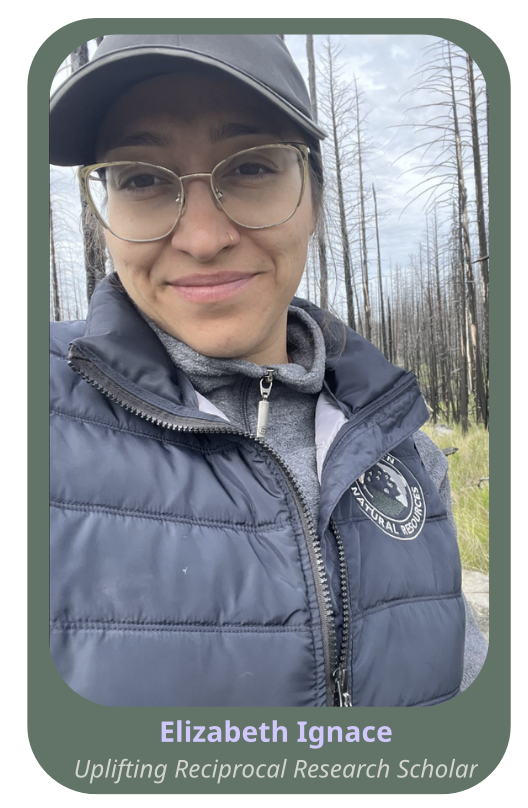
By: Elizabeth Ignace
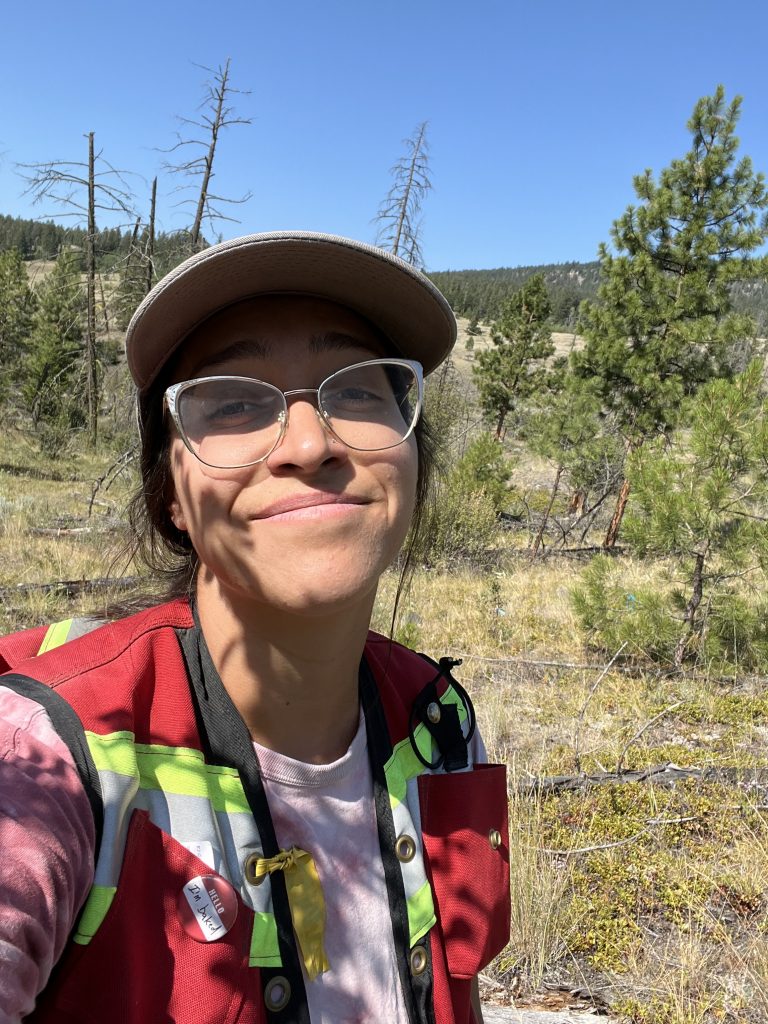
Weyt-kp! Elizabeth Ignace ren skwekwst. Ts’elpits’e7 ri7 ren xqelmecwésk’e. Te Skeetchestn re st’7e7kwen. Marianne Ignace ren ki7ce ell re Ron Ignace ren qe7tse. Le m-tsilkst te swucwt (2019) w7ec re e7elkstwen ne Skeetchestn Natural Resources Corporation. Ne tmicws-kucw, e7lkst-ken ne nkect, ne spelpélem ell ne sqeltús es p’7ecws es yecwmenúl’ecwems-kucw. Ts’xentéten nehé7e k w7ecténs re spipyúy7e, re tmesmescécen, re pep’í7se, ell xwexwéyt te stem es p’7ecws es yecwmíntem-kucw.
Hello, my name is Elizabeth Ts’elpits’e7 Ignace and I am from Skeetchestn Indian Band. Marianne Ignace is my mother and Ron Ignace is my father. I have worked with Skeetchestn Natural Resources Corporation (SNRC) since 2019. In our land, I work in the forest, the grasslands, and the mountains so we can look after the land better. I manage the birds, mammals, snakes and other animals so that we can better take care of them.
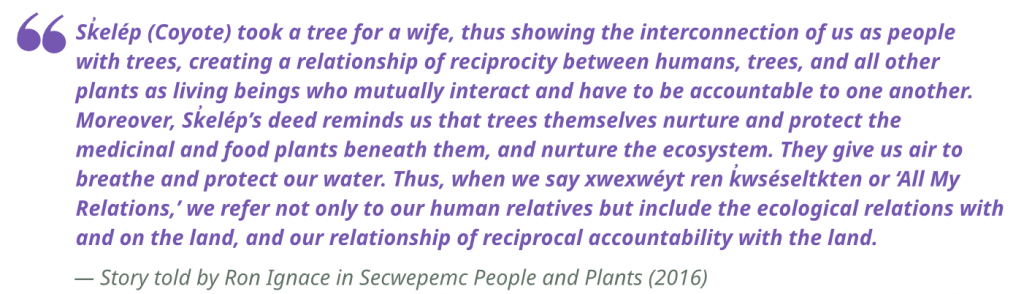
In Secwépemc culture, it is a common practice to introduce yourself and your family. As a Secwépemc mother and active community member, I choose to uphold my community’s traditional teachings. My work is guided by the teachings of our Elders and by the responsibility we have to uphold and repect our language, land and all living beings. By continuing to learn and speak Secwepemctsín, and by learning the old ways from my father as he learned from his great-grandparents, I am actively resisting the colonial pressures that have impacted my family and community. Through these acts, I continue to affirm the decades of attempts to suppress my culture, my language, and my people have not succeeded. I take immense pride in the resilience and strength that my family has demonstrated across generations. Oral Traditions, such as the story of Coyote and his wide, are teachings that I choose to live by in my research and in my life.
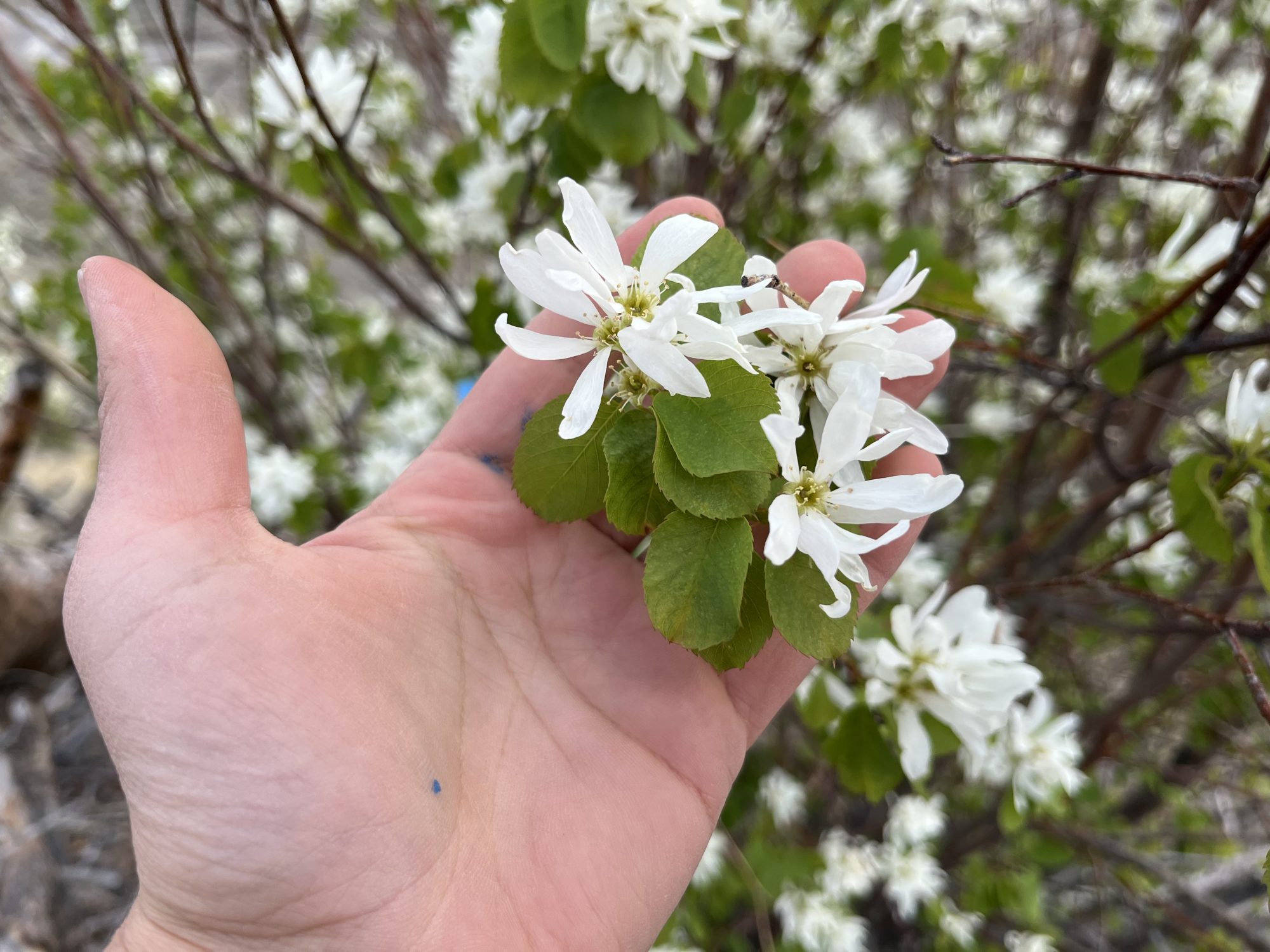
This Knowledge Highlight shares my PhD research on the revitalization and protection of saskatoon berries (Amelanchierspp.), a culturally and ecologically significant species central to Secwépemc identity, ceremony and food systems. I am completing this work through the University of British Columbia Okanagan in partnership with Skeetchestn Indian Band and Agriculture and Agri-Foods Canada. Grounded in my relationship to the land and to saskatoon berries themselves, my research brings together Indigenous Knowledge and western ecological science to support cultural resilience and climate adaptation.
Saskatoon berries, knowledge
Systems, and change
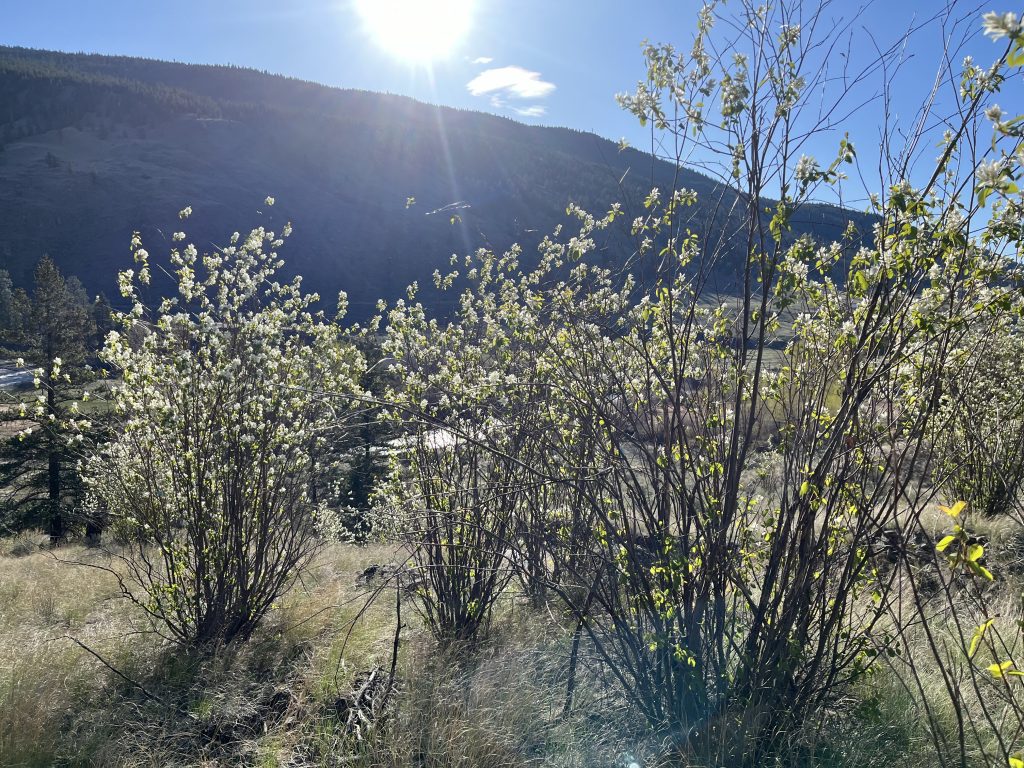
For Secwépemc peoples in the Interior of British Columbia, saskatoon berries are among the most culturally significant plant foods. In Skeetchestn Traditional Territory, saskatoon has long been considered the “essence” berry because of its abundance and importance for food, technology, medicine and ceremony (Ignace and Turner 2016). Secwépemc knowledge recognizes multiple types of saskatoon distinguished by habitat, flowering time, berry size, and taste. In Skeetchestn territory, three varieties are recognized: speqpequ7w’i, typically found in floodplain environments; steqwem, associated with dry hillside sites; and sencwesellp, an intermediate form found primarily in the mid-Fraser region. In contrast, western science has historically identified only two Saskatoon species in the interior of British Columbia: Amelanchier alnifolia and Amelanchier cusickii. Yet the genus is scientifically complex and difficult to classify due to variation and hybridization. As a result, the full diversity of saskatoon across the region remains poorly understood.
At the same time, many First Nations communities have observed declines in the abundance and quality of culturally important berry species. Colonial land management practices, including fire suppression, livestock grazing, logging, and landscape fragmentation, along with climate change, have altered berry habitats and harvesting areas. These ecological changes have occurred alongside disruptions to traditional harvesting practices and knowledge transmission resulting from colonial policies in Canada (Turner et al. 2013). In response to these changes, my research is motivated by the need to support both ecological understanding and cultural revitalization of saskatoon berries in Skeetchestn Traditional Territory. It asks how saskatoon berries are understood, classified, and experienced across the landscape; how Elders and Knowledge Holders have observed changes over time; whether ecological patterns align with Secwépemc berry classifications; and how environmental conditions shape berry quality and distribution. Ultimately, this work seeks to understand how Indigenous Knowledge and ecological science together can guide stewardship, restoration, and harvesting practices.
Research approach:
Walking on two legs
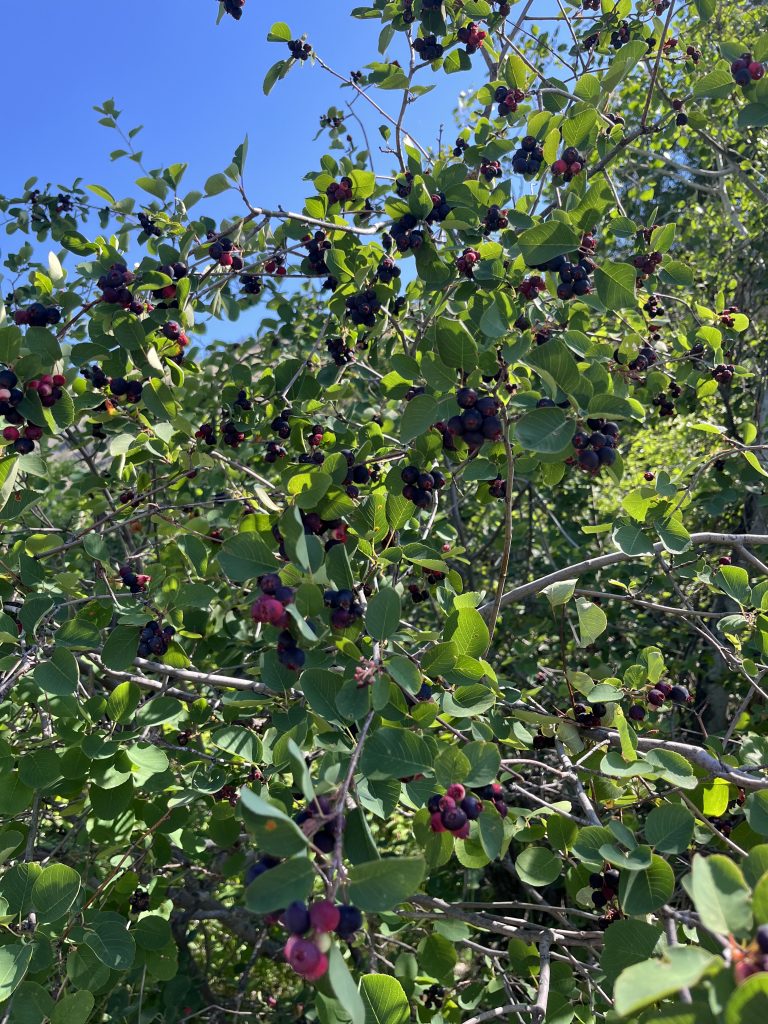
To address these questions, my research follows a “Walking on Two Legs” framework (Dickson-Hoyle et al. 2022), which brings together Indigenous Knowledge and western science as complementary ways of understanding ecological systems. Rather than treating these knowledge systems separately, this approach braids them together to create a more complete understanding of saskatoon ecology and cultural significance. This work begins with knowledge shared by Skeetchestn Elders, Knowledge Holders, and community members through conversations about harvesting practices, berry classification, and observed changes on the land. These teachings provide essential cultural context and guide the direction of the research. Ecological fieldwork then examines variation in saskatoon plants across the territory, including plant traits, environmental conditions, and genetic patterns, to understand whether distinct ecological groupings correspond with both scientific classifications and Secwépemc berry types. In addition, the research explores berry quality by examining physical and chemical characteristics and comparing these findings with community-defined indicators of desirable berries. Evaluating the berry quality and comparing the findings with community knowledge is a foundational part of my research as it centers on community knowledge in defining what a high-quality berry is, rather than solely relying as it centers on community knowledge in defining what a high-quality berry is, rather than solely relying on external scientific criteria . In doing so, this work supports the revitalization of traditional knowledge and practices, while contributing to food sovereignty by strengthening community capacity to harvest and manage culturally important foods such as saskatoon.
Throughout the project, the research is guided by principles of reciprocity, accountability, and respect for Secwépemc knowledge systems. Knowledge shared by Elders and community members remains under community ownership, and findings are returned through workshops, reports, and educational materials that support community priorities.
Significance and
Community impacts
In response to ongoing ecological and cultural changes, this research contirbues to both scientific understanding and community stewardship or saskatoon berries. By bringing together Indigenous Knowledge and ecological and genetic analysis, the study provides new insights into the diversity and environmental relationships of saskatoon plants in Skeetchestn Traditional Territory. More importantly, this work supports Skeetchestn’s efforts to strengthen food sovereignty, cultural knowledge transmission, and land stewardship. Understanding where different saskatoon types occur, and what environmental conditions support high-quality berries, can guide future harvesting, propagation, and restoration efforts. Documenting Secwépemc berry names and classifications alongside ecological research affirms that Indigenous taxonomy and western scientific classification can coexist and complement one another.
Grounded in relationships with Elders, community members, and the land itself, this research contributes to a broader movement toward Indigenous-led environmental research, climate adaptation, and culturally grounded land management across British Columbia. As Ron Ignace reflects, “The stories of my people are linked to the land… we belong to it and it belongs to us” (2018).
Climate Strategies and
disaster Risk Reduction
Building on this work, my research aligns closely with the BC First Nations Climate Strategy and Action Plan and the Action Plan for Disaster Risk Reduction (DRR) planning by centering Indigenous-led adaptation, ecosystem restoration, and intergenerational knowledge sharing. By bringing together Traditional Ecological Knowledge with environmental data, such as soil moisture, microclimate conditions, and genetic variation, this work supports Indigenous monitoring capacity and offers a model for tracking the health of culturally important species under changing climate conditions.
Elders have shared teachings about low-intensity cultural burns that were traditionally used to renew berry patches, enhance productivity, and reduce wildfire severity. These teachings inform the research and support ongoing efforts to reintroduce cultural fire practices into community and regional stewardship planning.
Mapping resilient saskatoon populations across the territory also strengthens food security and Secwépemc self-determination by guiding restoration and propagation priorities. Together, these approaches contribute to reclaiming traditional food systems in ways that reinforce climate resilience, cultural identity, and the long-term wellbeing of Secwépemc people and their homelands.

Looking forward
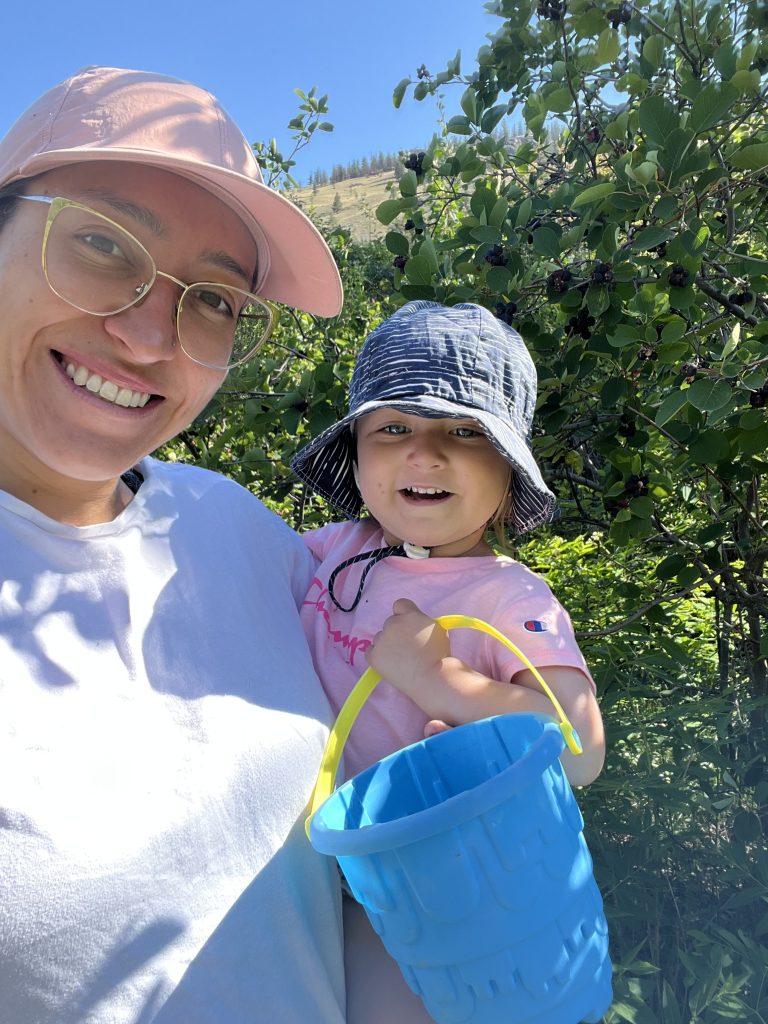
Looking ahead, this research opens pathways for deeper collaboration, renewed relationships, and long-term capacity building across Secwépemc Territory and beyond. Bringing Elders, youth, and scientists together on the land has demonstrated the strength that comes from combining story, language, and data in ways that honour both Indigenous Knowledge and ecological science.
As this work continues, these collaborations will remain grounded in mutual respect, recognizing that Indigenous Knowledge provides ecological insight that enriches scientific understanding. Partnerships with UBC, Agriculture and Agri-Food Canada, and Skeetchestn Indian Band create space for two-way learning, where both researchers and community members gain new skills and perspectives. Mentorship will remain central, ensuring opportunities for community members to learn both traditional harvesting practices and ecological monitoring methods.
here is also potential for broader application. The “Walking on Two Legs” approach used in this research offers a model for other First Nations working to braid Indigenous Knowledge with ecological science for culturally significant species. For researchers, this work highlights the importance of listening and allowing First Nations priorities to guide research questions. For governments and institutions, supporting First Nations-led monitoring, restoration, language revitalization, and Elder knowledge will be essential for building climate resilience.
Finally, looking forward means upholding the principle that research must give back more than it takes (Gram-Hanssen et al. 2022). As this research continues, it will prioritize sharing knowledge in culturally meaningful forms, supporting community-led restoration, and valuing ceremony and coordination as core components of research. In this way, the project will continue to grow not only as a body of scientific knowledge, but as a living relationship between plant, people, and place.
For me, this work is not only academic, but deeply personal. It is a continuation of the teachings passed down to me by my parents, my Elders, and my community. Spending time on the land with saskatoon berries, listening to stories and learning through practice. has strengthened my understanding of what it means to be in relationship with the land. This research is one way I can give back by supporting the revitalization of knowledge and practices that have always sustained our people. In doing so, I carry forward the responsibility to care for the land, just as it has always cared for us.
Elizabeth Ignace is a PhD candidate at the University of British Columbia, and a recipient of a PICS Uplifting Reciprocal Research Scholarship.

In honour of the Relationship Protocol between the Pacific Institute for Climate Solutions (PICS) and the First Nations Leadership Council (FNLC), this Knowledge Highlight series reflects PICS’ commitment to supporting the priorities of the BC First Nations Climate Strategy and Action Plan and the Action Plan for Disaster Risk Reduction by First Nations in BC through capacity building, research, and education.