by Alyssa Hill
Would people in your community accept the same level of risk for flooding, landslide or wildfire for a parking lot than they would for the local hospital, the fire hall, or a residential neighbourhood? As these types of hazards threaten communities across British Columbia more frequently due to climate change, local governments face difficult decisions about what to protect, where to build, and what level of risk is acceptable.
Risk tolerance policies can help local governments navigate these decisions by establishing criteria for managing the potential impacts of hazards. They provide a link between understanding a risk and deciding how to act. When risk tolerance is clearly assessed and defined, local decision makers can make more consistent and effective decisions that support public safety and longer-term community resilience.
What is risk tolerance?
Risk is the possibility that something bad could happen, considering a hazard, and the exposure and vulnerability of people, homes, and things of value to that hazard. Climate change will influence hazards and increase risk in certain regions. You can learn more about projected climate change in your region using the Plan2Adapt tool from the Pacific Climate Impacts Consortium.
Risk tolerance is broadly defined as the willingness to bear a risk. A risk tolerance policy is a decision-making tool that defines what levels of risk are acceptable, tolerable, or intolerable and what actions should follow.
There are many ways to set criteria for a risk tolerance policy (see the scoping review paper in this series). Risk tolerance policy should be based on what a community is willing to accept or tolerate. For example, a community may see building a parking lot in a floodplain as an acceptable risk, but a hospital or long-term care home in that same area as an unacceptable risk.
Local governments may use risk tolerance policy for anything from land use planning and development approvals to infrastructure decisions. For example, new development in a floodplain or on a steep slope may need to meet a minimum threshold for what is safe and acceptable to be approved. Risk tolerance policy may also guide community-wide risk assessments and planning for climate resilience. For example, the level of acceptable risk may be useful when assessing potential impacts of a hazard or deciding where, when, and how to invest in adaptation and risk reduction.
The risk tolerance gap in B.C.
There are no national or provincial methods, guidance, or minimum standards for creating risk tolerance criteria. A handful of local governments in B.C. have developed local risk tolerance criteria specifically for development, infrastructure, and land use decisions. (For example, see the District of North Vancouver, Cowichan Valley Regional District, Regional District of Central Kootenay).
In the absence of risk tolerance policies, local governments rely on qualified professionals to determine if a proposed activity or project is safe. While qualified professionals use standards as accepted within their field of expertise, the definition of what is safe should be tailored community-by-community. However, many local and First Nations governments don’t have the technical expertise, capacity, or funding at hand to develop their own criteria.
PICS research to bridge the policy gap
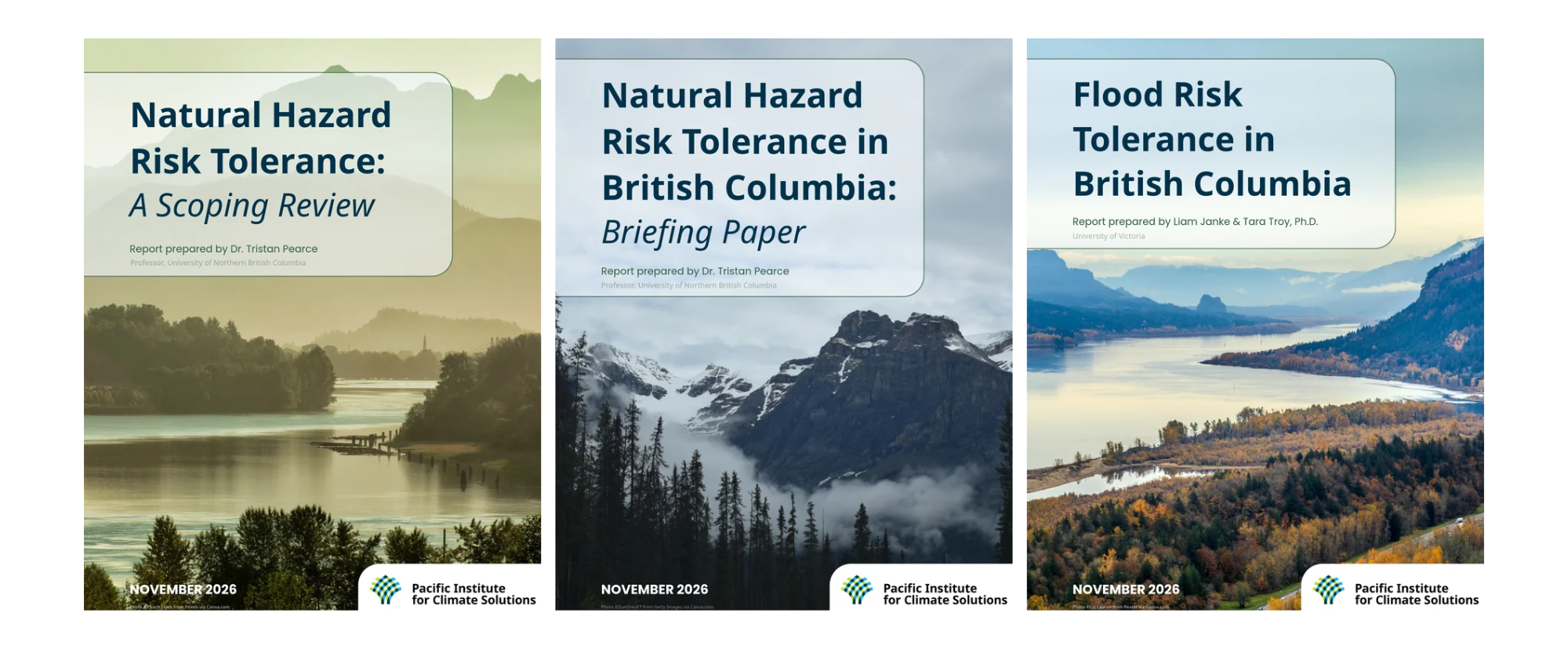
To support this gap and challenge, PICS commissioned three papers from our academic network around best practices for defining and applying risk tolerance, to support the development of risk tolerance criteria.
- Natural Hazard Risk Tolerance: A Scoping Review identifies best practices for defining and assessing risk tolerance
- Natural Hazard Risk Tolerance in British Columbia: Briefing Paper provides opportunities to operationalize risk tolerance in B.C.’s current risk assessment practice
- Flood Risk Tolerance in British Columbia focuses on flood risk standards and governance in B.C. to explore the implications of risk tolerance and how B.C. can shift to risk-based approaches
This research provides a foundation for local governments to continue developing risk tolerance policies. Further research could support both local governments and the province to move towards province-wide risk tolerance criteria. Risk tolerance is a key tool for making decisions about hazards in a changing climate and ultimately, protecting the communities, people, and things we care about.
Alyssa Hill is the Adaptation Impact Lead for the Pacific Institute for Climate Solutions.
Download the full suite of reports:

Natural Hazard Risk Tolerance: A Scoping Review
Best practices for defining and assessing risk tolerance.

Natural Hazard Risk Tolerance in British Columbia: Briefing Paper
Opportunities to operationalize risk tolerance in B.C.’s current risk assessment practice.

Flood Risk Tolerance in British Columbia
The implications of flood risk tolerance in B.C. and how the province can shift to risk-based approaches.