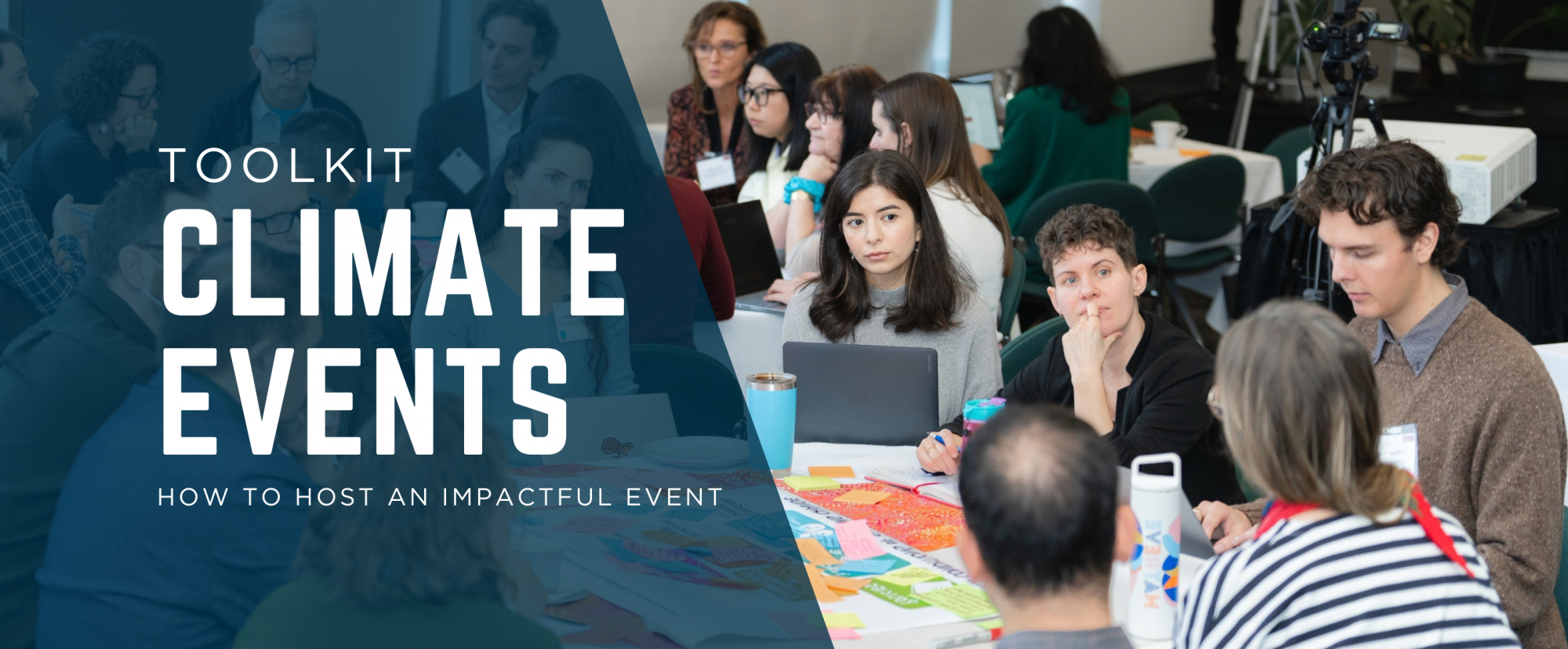
Events play a crucial role in turning climate information into action
Events can connect people, invite dialogue, forge partnerships, and activate communities. That’s why PICS supports events across British Columbia through the Community Climate Action and University Climate Knowledge Mobilization grant programs.
When events have impact, the magic doesn’t happen on its own; it takes hard work behind the scenes.
Event organizers are heroes in our books and we want to make your job a little easier. Whether your climate event is PICS-funded or not, this toolkit will help you host a successful event and create a bigger impact.
Organizers bring a wide range of experience, knowledge, and expertise to their work, and there is no one-size-fits-all approach to hosting a successful event. This toolkit is intended as a supportive resource, not a prescriptive guide. We hope you’ll find ideas, tools, or tips that are useful to you and your event.
BEFORE YOU START: Review these questions to boost your impact!
Whether you’re organizing a workshop, panel, or community gathering, the most successful climate events start with three simple questions. Get clear on what you’re trying to achieve and then plan for high impact results.
Question #1: What does success look like?
Before planning speakers, venues, or agendas, define the outcome.
- Is success about building new partnerships?
- Or sparking an important conversation or a concrete action?
- Maybe you want a particular decision-maker to be present and actively engaged?
The clearer your goal, the easier it is to design your event. The outcome you want will guide your planning decisions and help you achieve the results you want to see.
Question #2: Who do you want in the room?
Impactful events are not about attracting the biggest crowd — they bring together the people who can share critical knowledge, exchange ideas in key discussion, and move ideas into action.
Think about the outcome you are seeking – and then figure out who needs to be a part of making that happen. Durable climate solutions require a diversity of voices and perspectives.
Who is affected by the issue you’re talking about? And who holds power to facilitate change? Where might there be unexpected synergies? Are there opportunities to initiate new connections or build bridges?
Inclusion creates stronger potential for collaboration and joint solutions. Think beyond the usual attendees.
Question #3: What action do you want participants to take after the event?
Inspiration matters — but people are most motivated when they see how their efforts connect directly to actions.
Be specific. What can attendees do to help make the outcome you want to achieve a reality?
- Do you want attendees to join a network?
- Advocate for a change in policy?
- Start a local initiative?
Design your event around that next step. Give people tools, connections, and clear actions they can take immediately. They will leave feeling inspired and empowered.
The climate event toolkit includes:
Event planning resources
Checklists, tips, and templates — we’ve got you covered from planning to follow up!
Tips for climate event challenges
How to handle event planning in polarized and uncertain times.
Event success
story
A climate event success story featuring partners in Clayoquot Sound.
Event Planning Resources
Checklists, tips, and templates — we’ve got you covered!
Event Planning Checklist
Everything you need to do from planning to follow up all in one comprehensive checklist.
Facilitation Tips
Nail the opening, guide dialogue with ease, and navigate tensions like a pro with this concise summary of facilitation tips.
Why Evaluation Matters
All the reasons you can’t do without participant feedback as a tool for engagement and future improvement.
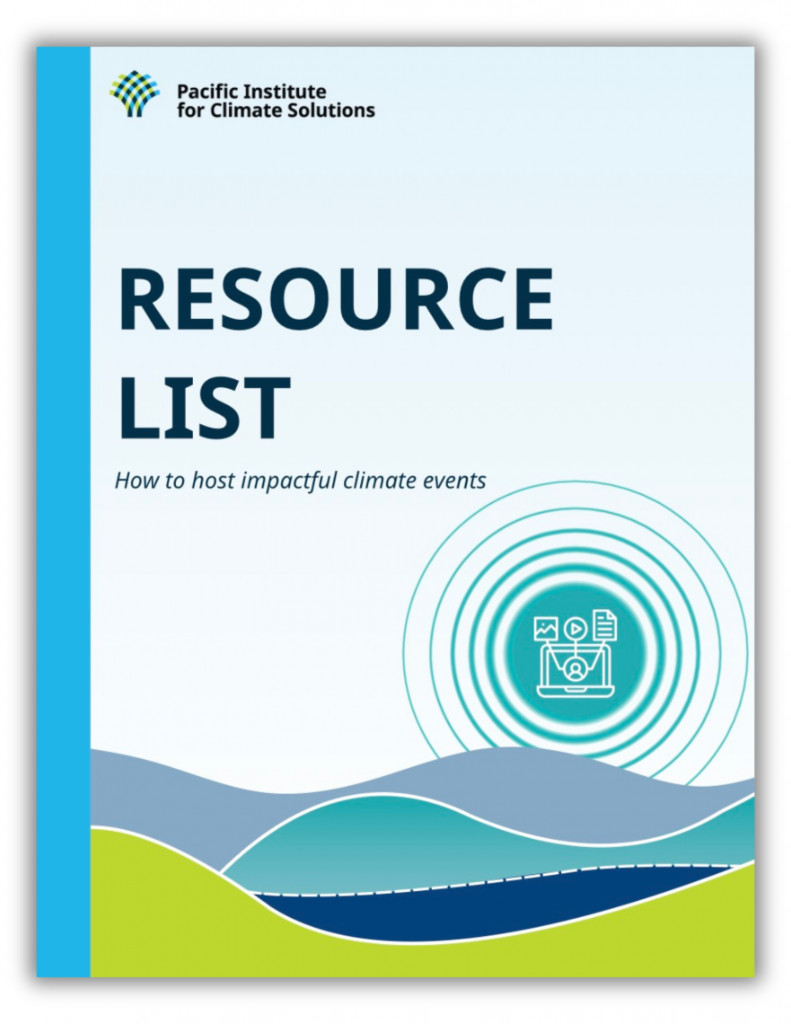
Engagement and Equity Resources
This guide directs you to in-depth advice to increase audience engagement and support equity, diversity, and inclusion in your events.

What makes a good photo?
Six tips to elevate your images and capture the impact of your event through better visual storytelling.
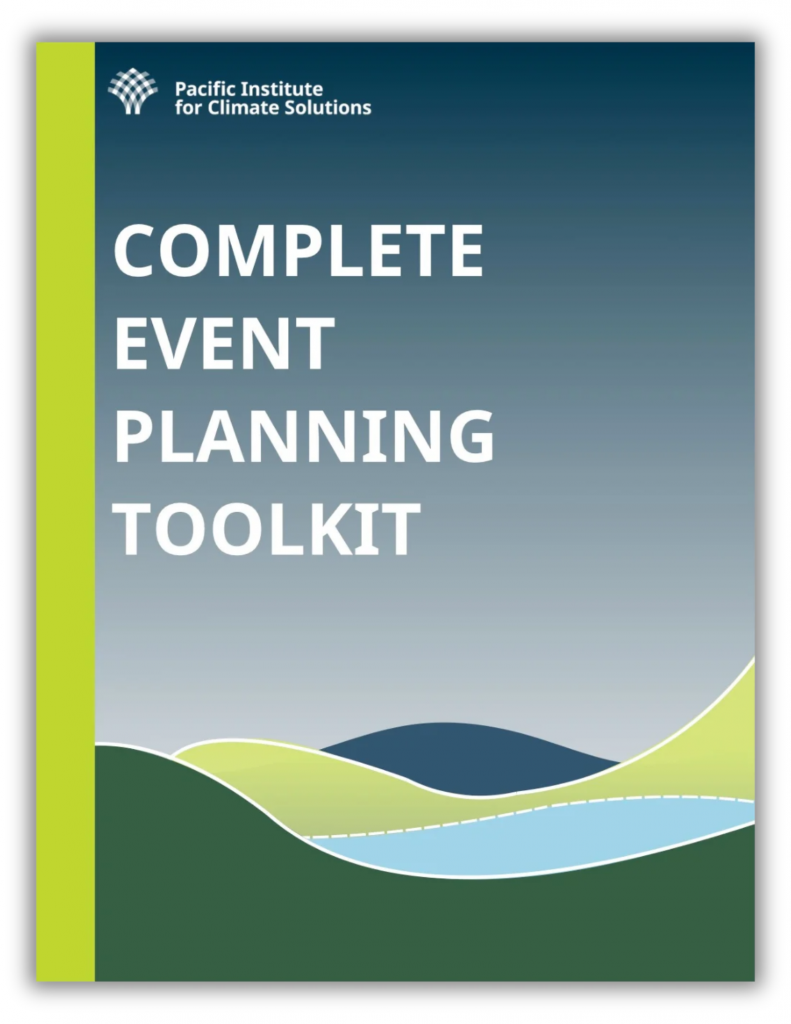
Complete event planning toolkit
Get all the toolkit resources all in one place.
Tips for climate event challenges
How to handle event planning in polarized and uncertain times.
What are the best sources if I want to share climate data at my event?
Research-backed information and climate data provide a strong foundation for any climate event. There is a growing set of publicly available data and interactive tools that make climate projections, climate risks, and climate resilience more accessible than ever.
Top sources for trusted B.C. climate information include:
- The Pacific Climate Impacts Consortium (PCIC) is a climate service provider at the University of Victoria that conducts and applies research focused on understanding climate change and its physical impacts, supporting adaptation efforts across B.C. PCIC offers analysis tools, data portals, and training to enable forecasting of climate impacts and analysis of historical weather and climate data.
- The ClimateReadyBC Data Portal provides publicly funded emergency, hazard, and risk information with data available at provincial, regional, and local levels.
- ClimateData.ca provides access to historical climate data, seasonal to decadal forecasts, future climate projections and related guidance and analysis tools. The platform includes data for temperature, precipitation and other climatic variables, as well as interactive maps, graphs, and educational resources.
- Climate Atlas Canada is an interactive tool combining climate science, mapping, and storytelling to bring the global issue of climate change closer to home. It’s designed to inspire local, regional, and national action and solutions.
- HealthyPlan.City guides targeted interventions to improve local environments, promote public health, and enhance climate resilience.
- The PICS Climate Insights Course is a self-paced, online course for those who want to learn more about climate change and make informed decisions, create sustainable policies, and advance climate action.
How can I get decision-makers in the room?
Having political, business or other decision makers at your event can do a lot to increase event impact and raise the profile of your initiative. Decisionmaker participation provides a valuable relationship building opportunity and could be the first step towards unlocking investments, action, or policy change.
Getting decisionmakers out to your event is worth extra effort, here are tips to make it happen:
- Create a prominent role for the decisionmaker at your event – This could be as simple as asking them to open and close the event, participate in a panel or provide an “insider presentation” to share their unique perspective as a decisionmaker.
- Share a professional invite and be clear on benefits – your invite might start with an email to the decisionmaker sharing the event details and involvement opportunity. Decisionmakers are often very busy with competing demands. Think about what benefits attending your event will bring to them and include this in your initial invite and any follow-up. Make sure communication is polished and professional.
- Leverage your connections – An email invite might not trigger a response. If that’s the case, leverage your network. Is there someone you know who has a direct connection to the decisionmaker? Is there an event the decisionmaker will attend where you could show up and make an in-person pitch?
- Follow up and allies – If you don’t hear back, follow up with a phone call to the office–many busy people can’t find the time to answer an email but will offer a few minutes of time on the phone. Administrative staff can help get your invite to the top of the pile, ask for their advice.
What do I do once the decision-maker is confirmed?
- Send a calendar invite – Once you have a decisionmaker committed send a calendar invite with all the details that they can easily accept and integrate into their calendar system.
- Event day introductions and thank you’s – Ensure they are greeted warmly at the event and make introductions to key staff or partners. At the end of the event, thank them for attending.
- Confirm next steps for action – The end of the event is a good time to ask the decisionmaker how proposed actions or ideas can best be moved forward in their sphere of influence. They often have good tips or suggestions for follow up and may offer tangible next steps.
- Promote on social media – If the decisionmaker is on social media, LinkedIn or Facebook are popular, take a picture with them at, or after, the event and tag them in an event follow-up post acknowledging their presence and contribution. This allows you to put your event on the radar of the decisionmaker’s network and show they are engaged with your topic.
How do I handle climate misinformation and disinformation?
Gossip and falsehoods have always been with us, but in a media environment where disinformation is monetized and sophisticated technologies of deception are widely accessible, the influence of misinformation and disinformation is growing exponentially. Misinformation is when someone shares content they believe is correct without intending harm. Disinformation is a deliberate effort to mislead and obstruct action, most often for money.
Misinformation and disinformation can affect the conversations and perspectives shared at your climate event. Event organizers can prepare to handle misinformation and disinformation by understanding the forces behind them and equipping themselves with a few key strategies to address incorrect information if it arises.
When planning your event, consider how much misinformation and disinformation could play a role in event discussions or Q & A. If you will have a diverse group of participants drawing from a range of information sources, choosing speakers or topics that will resonate with the diversity of perspectives could be a wise strategy. You might also want to include a speaker or facilitator who can tactfully offer a counterpoint to misinformation or disinformation.
Learn more about mis and disinformation and how to address it:
- Climate Caucus: Addressing climate misinformation and conspiracy theories
- Climate Access: Combatting False Climate Narratives (guidance and webinar)
- Union of Concerned Scientists: Disinformation Playbook
How do I navigate climate grief during an event?
Climate change is a daunting and complex threat that can lead to distressing emotions, such as anxiety, depression, grief, and hopelessness. Climate grief is an umbrella term linked to the losses individuals and communities are experiencing as the result of lived experience with climate impacts. These emotions can arise from observed or anticipated losses related to ecosystems, nonhuman communities, and meaningful landscapes due to acute or chronic environmental change. Climate grief can be exacerbated by the lack of cultural support and social acknowledgement.
Depending on your event type and content, you may want to have support for climate grief in place for event participants.
Simply acknowledging that topics might be difficult is a valuable step. This can be done in advance as well as during the event. Creating optional opportunities for sharing or exchange and providing access to supplemental resources are some ways event organizers can support climate grief.
These climate grief resources can help you plan a supportive event:
- Climate Atlas of Canada: Taking Action on Our Climate Emotions offers an overview of climate grief and guidance from mental health professionals on working through emotions, turning distress into action, and finding positive meaning within the climate crisis.
- Indigenous Climate Hub: The emotional impact of climate change shares an overview of climate grief from an Indigenous perspective
- UBC: Addressing and coping with climate grief: A toolkit for group and individual use shares activities, including icebreakers, ecotherapy, and mindfulness, to support individuals and groups navigate climate grief that could be applied in an event setting.
- Indigenous Climate Hub: Health the land, healing ourselves: Climate grief and Indigenous ceremonial practices shares how Indigenous-led ceremonial practices are emerging—or re-emerging—as sacred responses to ecological loss, planetary crisis, and climate grief.
- UBC: Programs and Interventions to Address Climate Grief: A case studies report provides a summary of 18 case studies of interventions used to address, mitigate or prevent climate grief within a population, community, or individual that can offer inspiration for embedding climate grief support into an event.
How do I keep up the momentum for action after the event?
The best way to keep up momentum for climate action after the event is to build action into your event and to have next steps plotted out ahead of time, or with event participants.
While planning your event, think about the next steps you’d like participants to take after the event. Maybe you’d like them to join the next event in a series to build momentum or perhaps the event activities will include definition of what action will look like.
From building a network to starting a local initiative or advocating for change, creating the momentum towards those actions during the event will increase the likelihood of participants following through. The desired next steps can also guide event content. You may want to include speakers who have accomplished similar things or make time for activities that help people take initial steps during the event.
Don’t forget to follow up after the event to cement good intentions. Share resources, success stories, and ways for people to continue to connect to take action together.
Climate event success story
How Clayoquot Sound partners catalyzed climate action with a well-planned event.
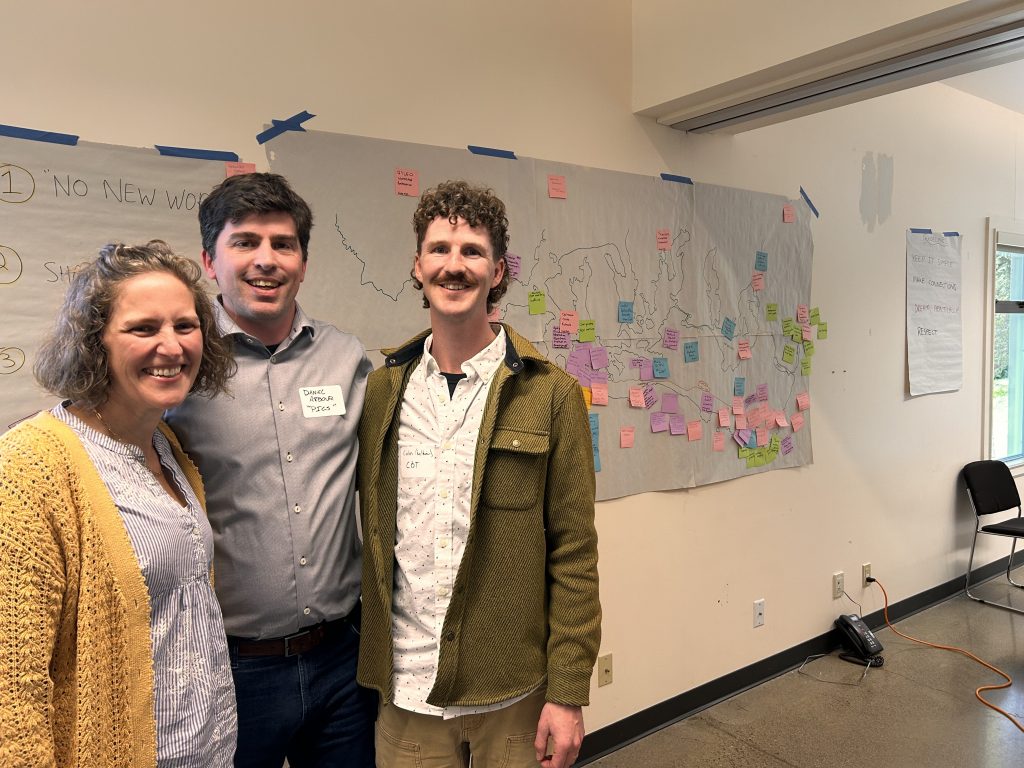
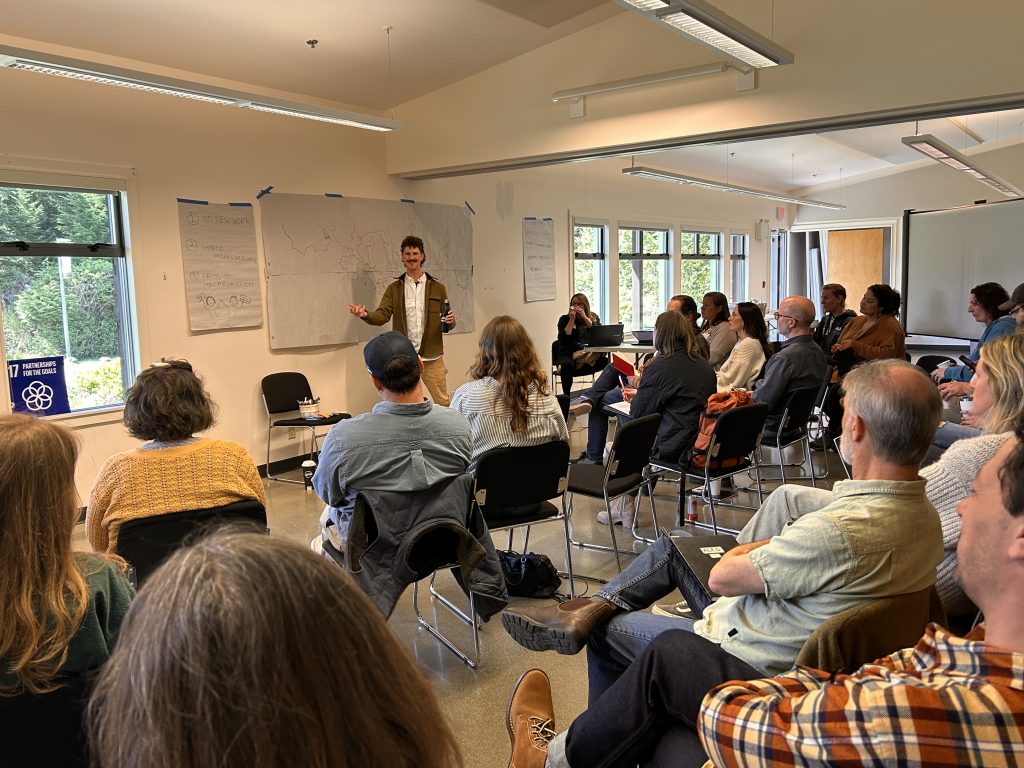
Left: Clayoquot Biosphere Trust executive director Rebecca Hurwitz (left) and program coordinator Colin Robinson (right) with PICS granting and partnerships specialist Daniel Arbour (middle). Right: Colin Robinson speaks to event participants.
In April 2025, a single, well‑designed convening brought Indigenous Nations, municipalities, the Alberni-Clayoquot Regional District (ACRD), Island Health, non-profit leaders, and a potential funder into the same room. The result has been meaningful regional-level partnership to collaborate on community climate adaptation and made it possible to secure substantial climate planning and infrastructure funding for partnering communities.
As part of the event design, The Clayoquot Biosphere Trust applied and received a PICS Community Climate Action Event grant, with the goal of hosting diverse community partners to discuss climate adaptation infrastructure needs. The event, hosted in partnership with the ACRD, was designed to initiate a regional approach to pursue climate grant funding and implementation. During the event, participating communities identified administrative barriers to the work, and ACRD stepped forward to offer highly valuable administrative support for collaborative projects between communities. Participants also specifically explored the potential to co-apply for a Federation of Canadian Municipalities (FCM) Local Leadership for Climate Adaptation planning grant.
As part of event planning, organizer Colin Robinson invited a representative from the Federation of Canadian Municipalities (FCM) Green Municipal Fund to give a presentation explaining the funding opportunity. This was a critical component of the event because bringing a decisionmaker into the room helped participants better understand the opportunity. Participating in the event also provided the potential funder a chance to learn about the context, issues, and groups involved.
“Through our Vital Conversation climate event, the Clayoquot Biosphere Trust was able to bring together multiple First Nation communities and local governments and secure climate adaptation funding for our region.”
— Collin Robinson, Program Coordinator
After the event, the group decided to coordinate grant applications by the Tla-o-quiaht, Yuu-tluth-aaht, Tla-o-qui-aht, District of Tofino, and District of Ucluelet communities. One year later, FCM announced that each of the five communities had been selected for $70,000 grant awards for climate adaptation infrastructure planning. Once this work is completed, the five communities will be eligible for Stage 2 funding, which could potentially result in millions of dollars in climate adaptation infrastructure investments in the region.
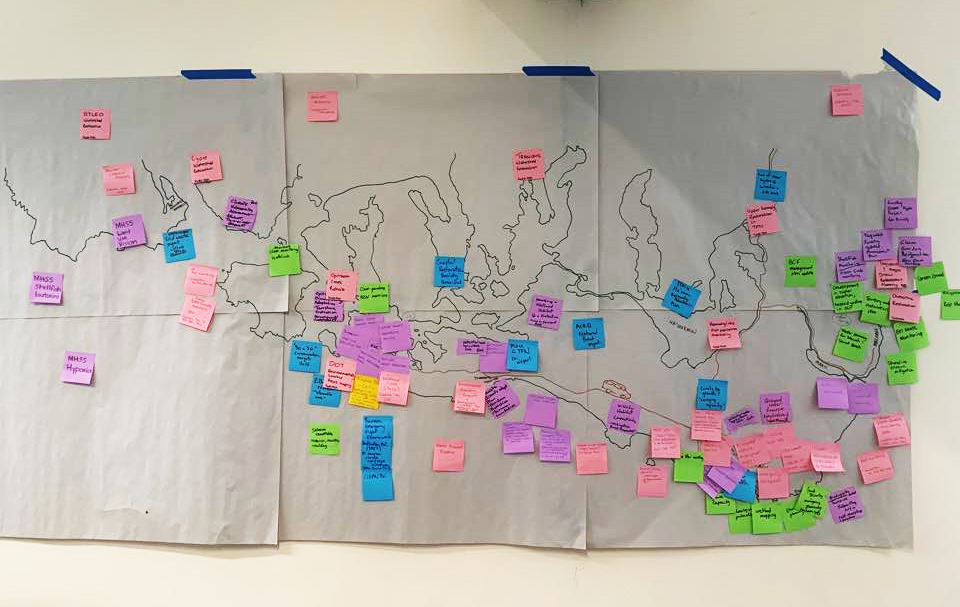
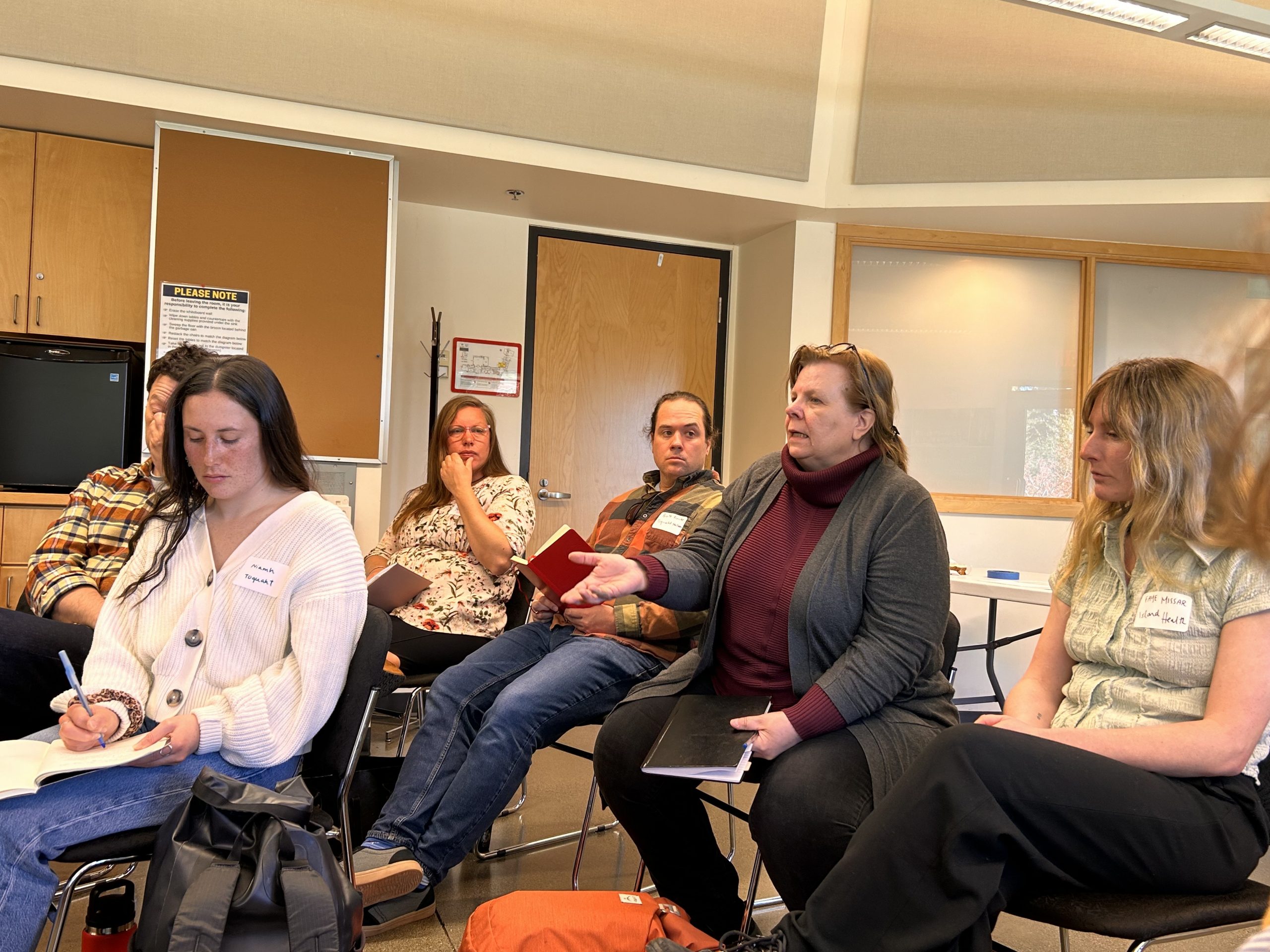
Left: A collaborative map was created throughout the event that highlighted regional climate needs, priorities, and programs. Right: Event attendees participate in a group discussion.